Fruitful Living
About this Episode
Episode Summary
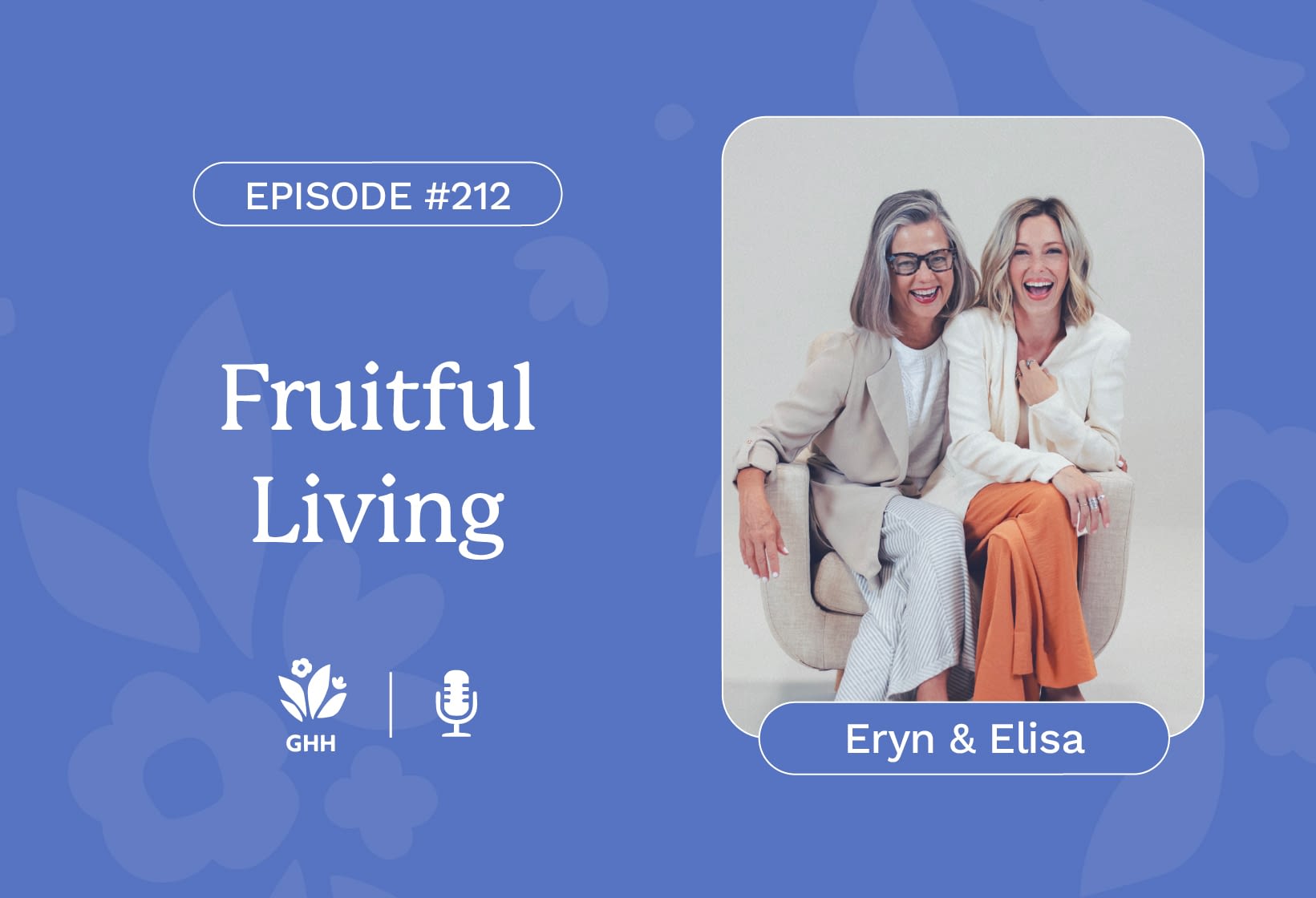
Which fruit of the Spirit do you struggle with? As we work to be more Christlike, we often struggle with different Spirit-produced characteristics in different seasons of life. In this special God Hears Her conversation hosted by Eryn Eddy Adkins, Elisa Morgan invites us to consider the fruit of the Spirit and how we can grow in these qualities of character to reflect Jesus in everything we do.
Episode Transcript
God Hears Her Podcast
Episode 212 Fruitful Living
Elisa Morgan & Eryn Adkins
[Music]
Vivian: You are listening to, God Hears Her a podcast for women where we explore the stunning truth that God hears you. Join our community of encouraging one another and learning to lean on God through Scripture, story, and conversation at godhearsher.org. God hears her, seek and she will find.
Eryn: Hey friends, before we get started, feel free to download or print our new Bible study show notes to fill out while you listen. You can find those on our website. Now, let’s dive into this God Hears Her conversation.
Elisa: We are doing a God Hears Her podcast Bible study.
Eryn: That’s right.
Elisa: We’re really glad you’re here. We’re really glad you’re here, and really pray that something that God does between us today, connects with you and what you’re going through right now.
Eryn: Yeah.
Elisa: So Eryn.
Eryn: That’s a good word.
Elisa: I wanted to lead us in…
Eryn: Yeah, tell us.
Elisa: …with the concept of legacy. What is legacy, and how do you leave one? Do you know what that word even means? I mean, you just lost your grandmother not too long ago.
Eryn: Yeah.
Elisa: And she was probably one of the greatest legacy influencers in your life, right?
Eryn: Yeah, yeah. She was heavily influential in our family and all the generations that surround her.
Elisa: Mm-hmm. She was a little entrepreneur. I know that. Legacy is…is like, um, what you leave behind, you know, after you depart. And…
Eryn: Yeah.
Elisa: …you might be a little young to think about it, but I don’t think so. And I’m a little bit older, and it’s good for me to think about it, but I think we all need to. And as I’ve been rounding into more advanced years, I’ve been thinking what really matters in my life, especially when I can’t do any longer?
Eryn: Hmm.
Elisa: So I’ve been kind of studying this.
Eryn: Yeah.
Elisa: And I think one of the answers to this question comes from a guy named Henri Nouwen and his, in his book, he talks about the gift of years. He talks about our legacy isn’t so much our achievements as our character. And that’s why I brought up your grandmother. Because you know, if you thought of people who are leaving a legacy, she had character, right?
Eryn: Yeah, she did.
Elisa: So tell us a little about her character. Some of it was kind of character, right? Yeah.
Eryn: Well, she was very gritty.
Elisa: Mm-hmm.
Eryn: And when I say gritty, it’s…she had no problem walking towards the mess and also dreaming. Like, she never was jaded. She always was extremely optimistic about the future, even if her present was hard.
Elisa: Okay.
Eryn: Um, I think that takes a level of resiliency.
Elisa: It does.
Elisa: I think, uh, she was very self-aware, very much into personal development. That’s where I get some of it.
Elisa: Mm-hmm.
Eryn: She, oh man, I don’t want to cry thinking about my grandma.
Elisa: Sorry baby. What was her name? Oh no, I’m sorry.
Eryn: [inaudible]
Elisa: Okay.
Eryn: My chin does this little thing anytime.
Elisa: Okay, all right. We won’t…we won’t watch your chin. All right, love you. You don’t have to, I can go next.
Eryn: No her…no, I can talk about it. No.
Elisa: Okay, okay.
Eryn: So her…her name’s Joyce Eddy.
Elisa: Joyce.
Eryn: Yeah.
Elisa: But what’d you call her?
Eryn: Grandma.
Elisa: Grandma.
Eryn: Yeah. And she never had like a…she…she was like your non-traditional grandma though. Like, cause she was an entrepreneur, and she was recognized by Ronald Reagan as businessperson of the year.
Elisa: Wow.
Eryn: Her business grew super fast within 10 years. She went through a divorce when she was 30, and she started her business when she was 40. She had two boys and uh, she started the business with them. And she was one of seven kids. And she, when you say legacy, she made sure that each one of her siblings were…they were taken care of. And she supported them in ways that they financially couldn’t be supported in different times of life. And it was never, um, something for her that she felt like she had to do, uh, or felt like a boundary was being crossed. She was just an extremely generous, resilient woman.
Elisa: Don’t you just hear a lot of qualities as you’re describing her? So, I mean, she did a lot of things. So there were those achievements. But here’s the character. Now I’m gonna talk about my grandmother for a minute.
Eryn: Okay.
Elisa: We called her Munna.
Eryn: Oh, that’s a cute name.
Elisa: M-U-N-N-A. Yeah.
Eryn: Munna.
Elisa: Yeah, Munna. And my grandfather was Bop, so it was Munna and Bop. Yeah.
Eryn: That’s really cute.
Elisa: Yeah. My Munna was a seamstress. And she would quilt. She won some kind of a state of Texas sewing contest when she was 18. And I still had that little dress that she made is so pretty.
Eryn: Oh.
Elisa: Yeah, and she did quilts and stuff, and she taught me how to make…well, how to sew. And my first item I created was culottes.
Eryn: Oh, that’s awesome. Oh my gosh.
Elisa: I know…remember back in the day. No, you weren’t even born. Anyway…
Eryn: I know. I don’t really remember culottes. The only…the only reason I know…
Elisa: So much.
Eryn: …them is because you talk about them.
[laughter]
Elisa: That’s it. That’s it. That’s it. But she also had a dessert for each family member.
Eryn: Yeah.
Elisa: And mine was peppermint ice cream pie, which I made for my kids, and now I make for my grandkids. And she would also play the organ, and she would just belt out “The Night Before Christmas” and “The Lord’s Prayer” with a [sound effect] you know, the whole thing. So she just was so vivid.
Eryn: Oh, you painted a really good picture of her. I could just see, and I don’t even know.
Elisa: Oh, thank you. Well, I’m thinking of these two women.
Eryn: Yeah.
Elisa: Because I think most of us, no matter what our age, we want to grow a life that matters. You know, we want to leave a legacy of character. And so I want to push us into a section of Scripture that actually describes the kind of qualities that God can produce in us when we lean into Him and invite Him to grow Himself in who we are, in Eryn, in Elisa, and everybody, all of us who are here. We’re going to be in Galatians 5 today, the very end of chapter 5 like in verse 13 or so. Paul writes, “You, my brothers and sisters were called to be free, but don’t use your freedom to indulge the flesh.” And he goes onto this kind of [sound effect] things of, you know, the works of the flesh. Do you see those there? Like in verse…
Eryn: Uh, right here.
Elisa: …17…17.
Eryn: Yeah, I do. I see that.
Elisa: Okay, read some of those.
Eryn: Um, okay. So “For the flesh desires, what is against the Spirit; and the Spirit desires what is against the flesh. These are opposed to each other so that you don’t do what you want. But if you’re led by the Spirit, you are not under the law.”
Elisa: Okay, now, verse 19, read some of the icky things.
Eryn: “Now the works of the flesh are obvious. Sexual immorality, moral impurity, promiscuity, idolatry, sorcery, hatred, strife, jealousy, outbursts of anger, selfish ambitions, dissensions, factions. What are dissensions?
Elisa: That’s, um, arguments.
Eryn: Oh.
Elisa: Yeah, divisiveness.
Eryn: What are factions?
Elisa: Same thing.
Eryn: Okay. Envy…
Elisa: Yeah.
Eryn: …drunkenness.
Elisa: Orgies and the like is in my version. Okay. That’s just stuff we don’t want to do.
Eryn: Oof.
Elisa: Okay. So what Paul has a saying…
Eryn: That’s a lot. There’s a lot there.
Elisa: …is that we’re freed from the law. We don’t have to be perfect. He’s writing to this whole church that’s been stuck on that stuff. We don’t have to be perfect. We can be free. But don’t use your freedom for all that dark stuff…
Eryn: Yeah.
Elisa: …that’s gonna tear down your character.
Eryn: Right.
Elisa: Instead, now, this is the really good part, verse 22, “But the fruit of the Spirit is…
Eryn: Mm-hmm, “love, joy, peace, patience, kindness, goodness, faithfulness, gentleness, and self-control.”
Elisa: “And against these, there’s no law.”
Eryn: The, yeah, the law is not against such things.
Elisa: Right. “Those who belong to Christ Jesus have crucified the flesh. And since we live by the Spirit, let’s keep in step with the Spirit.”
Eryn: Mm.
Elisa: So, legacy, leaving a legacy, growing a life that matters is about these qualities being our personalities. That sounds so good.
Eryn: Yeah.
Elisa: Doesn’t it?
Eryn: Yeah, it does. It does, don’t it? Yeah, it’s really hard to do.
Elisa: Yeah.
Eryn: Yeah.
Elisa: Why? Why do you say that?
Eryn: Oh, I mean, just predispositions to just our, you know, maybe some things that we’ve come from, we grew up in. Maybe our friends that surround us…
Elisa: Yeah.
Eryn: …can influence us differently.
Elisa: That’s good, both of those.
Eryn: Shapes the way we see the world. Um, yeah. It’s hard. It’s just hard. cause there’s temptations.
Elisa: Well, we’re human.
Eryn: Yeah.
Elisa: And we’re human. You know, I look at these and I…I especially apply it to mothering. And we’ve talked a lot about mothering, you know, as you’ve become a stepmom and I’m a grandma and a mom,. And I look at those thing and I…I think, well that sounds like you’re gonna be Mother Teresa, you know?
Eryn: Yeah.
Elisa: Cause she was just like [bing].
Eryn: Yeah.
Elisa: Even though she had doubts at times, she was amazing. And I think Mother Teresa, Mother Elisa, not exactly, you know, the same. And so I look at these, and I feel really overwhelmed. And I think there’s a couple of presumptions that we make or assumptions that we make when we look at this list.
Eryn: Yeah.
Elisa: And I think one of them is that we think they’re all up to us to grow.
Eryn: Yeah.
Elisa: Like I’m supposed to get up in the morning and…and read my Bible and think about being self-controlled.
Eryn: It’s almost like we’re trying to manufacture it ourselves.
Elisa: Exactly.
Eryn: Yeah.
Elisa: Yeah.
Eryn: That’s true.
Elisa: The reality is that just like with your shoe size, your eye color, you know, whether or not you’re gonna be bald as a guy, you know, those things are in your genetics. You don’t have any control over them, but the fruit of the Spirit is what God grows in us by the power of His Spirit. And our job is to cooperate with Him.
Eryn: Yeah.
Elisa: That’s it. I’m gonna start…I’m gonna turn over to Jeremiah 17…
Eryn: Let me get it.
Elisa: …verse…
Eryn: There it is.
Elisa: …7 and 8. I’ll keep reading while you’re finding it, because I think this describes a relationship with God where we actually plant ourselves in a relationship. And when we do that, He can grow these fruit…fruits in our lives.
Eryn: Okay.
Elisa: So do you want to read verses 7 and 8 of Jeremiah 17?
Eryn: Oh, I have it underlined. Look at that. I guess I’ve done this study.
Elisa: Okay, go on.
Eryn: No. “The person who trusts in the Lord, whose confidence indeed is the Lord is blessed. He will be like a tree planted by water. It sends its roots out toward a stream. It doesn’t fear when heat comes, and its foliage remains green. It will not worry in a year of drought or cease producing fruit.”
Elisa: What’s that last line?
Eryn: “Or cease producing fruit.”
Elisa: And my NIV says “never fails to bear fruit.” So it’s like a tree planted by the water, planted in a relationship. So it’s not up to us to grow the fruit.
Eryn: Yeah.
Elisa: It’s up to God to grow the fruit. But we have the opportunity to cooperate with Him as the fruit producer, the orchard keeper in our lives.
Eryn: Yeah.
Elisa: Okay, I think there’s a second presumption that we bring to this passage and that is that the fruit of the Spirit is about being nice all the time.
Eryn: Oh, yeah.
Elisa: Yeah.
Eryn: Well, you can get walked on.
Elisa: Yeah.
Eryn: All over if you do that.
Elisa: Absolutely.
Eryn: Right.
Elisa: And you know if you’re gonna be loving and joyful and patient and kind, those are all really nice words. But think about it this way, Jesus was always fruit-filled.
Eryn: Right.
Elisa: He was always loving and joyful and peace and patient and kind and self-controlled. But was He always nice?
Eryn: No. He was always kind. And I think there’s a difference between nice and kind.
Elisa: Okay, so when did you see Jesus not necessarily looking nice?
Eryn: Flipping tables.
Elisa: Yeah.
[laughter]
Elisa: That works, in the temple when He was really upset about how people were using the house of God, right?
Eryn: I…I do often think about how He was even protecting the adulterous woman when He got on the ground.
Elisa: Excellent. Yes, yes. When He is start write on the ground. And He knows all the men knew what she was doing…
Eryn: Right.
Elisa: …you know? But there was some guy with her, you know.
Eryn: Yeah, right.
Elisa: Where’s he?
Eryn: Right.
Elisa: You know, so He’s…He’s telling the truth, but it’s not nice. It wasn’t nice to let the disciples struggle in the boat in the middle of a storm.
Eryn: Mm-hmm.
Elisa: He’s asleep.
Eryn: Yeah, he’s asleep.
Elisa: Totally peaceful but not nice. So I think that is another myth that we need to be debunk. So the fruit of the Spirit is not all up to us to grow.
Eryn: Yeah.
Elisa: And it’s not about being nice all the time.
Eryn: Yeah, yeah.
Elisa: Okay. So in order to…
Eryn: It’s being kind, and kind looks like delivering the truth.
Elisa: And kind is a fruit.
Eryn: Yes.
Elisa: Kindness is a fruit.
Eryn: Right.
Elisa: So we’re gonna see that. Because what I want to do now is help us unpack these words, help us peel back the fruit, you know, and get to what is this fruit? What does it really look like? If we want to grow a life that matters, it’s gonna be a life that’s fruit-filled.
Eryn: Yeah.
Elisa: So…
Eryn: Okay.
Elisa: I brought along a little prop.
Eryn: Oh, I’m here for it. It’s right here. Oh, look how beautiful that is.
Elisa: I know.
Elisa: And what I like to do, because I think it makes sense for us all…
Eryn: Those grapes are no joke.
Elisa: …is to have a memory device to help us remember what each of the fruit is about. Now before I go into them, it’s the fruit of the Spirit.
Eryn: Yes.
Elisa: Now, is that a plural or a singular word? You don’t have to have the right answer.
Eryn: Yeah, okay.
Elisa: That’s really confusing.
Eryn: It is confusing, yeah.
Elisa: It’s actually a plural word. And it means there are lots of fruits because it’s not just one quality that looks like Jesus.
Eryn: Right.
Elisa: It’s nine qualities.
Eryn: Right.
Elisa: So the very first one is love. And for love, I picked grapes.
Eryn: Okay.
Elisa: Because they represent a cluster of relationships that are connected. And love, the definition, is being there, committed in all things. Think about who in your life you are there with and committed in all things.
Eryn: Oh, I know someone.
Elisa: Do you now?
Eryn: My husband.
Elisa: Your husband, yeah, yeah your husband. And…and love is being there in the tough times. It’s being there in the good times. It’s a commitment to stay. I like to say it’s a no matter what kind of love, no matter what you do, no matter what I feel.
Eryn: Yeah, no matter what I feel. That’s one.
Elisa: Take…take that one away. Yeah, that’s a big one, isn’t it? Especially in marriage.
Eryn: Yep. You can be led so much with your feelings.
Elisa: But also with kids. You know, um, being there in everything, committed in everything, no matter what you do. So, love, and then joy.
Eryn: Joy.
Elisa: For joy, I chose a cherry, which I don’t know if we have any. No, don’t see any cherries in there. And I chose a cherry because joy is confidence in God. What’s in the middle of a cherry?
Eryn: A nut.
Elisa: Yeah.
Eryn: Or a seed.
Elisa: A pit.
Eryn: Pit, exactly.
Elisa: Exactly, a stone. Some people would say, so joy is a really sweet fruit. But when you bite into it, there’s a pit.
Eryn: Yeah.
Elisa: Okay, I’m gonna share when…when Evan and I got married, we knew we couldn’t have children biologically. Joy came when we understood that God would bring us children through adoption. It’s confidence in God no matter the circumstances. Happiness is dependent on circumstances. It comes to the root of hap…[happenance]…happenstance.
Eryn: Okay.
Elisa: Joy is regardless of circumstances. So can you think of a time when you’ve seen the fruit of joy, confidence in God grow in your life despite the circumstances?
Eryn: Yeah, I mean, I think about…I have a few memories that immediately pop up. I think there was a time in when I was single, and I was really wrestling with like loneliness and trying to find joy amidst feeling alone and uncertain of the future of what He was gonna do in my life. And even how He was gonna redeem some of the messy baggage…
Elisa: Exactly.
Eryn: …the mistakes.
Elisa: Joy goes with messy, it comes out of messy.
Eryn: Yes. And, uh, on the other…I had…the only way for me to enjoy the process was to really surrender it to God and fight my negative thinking, uh, fight my fear, uh, fight my doubt in Him, um, knowing He has been faithful before.
Elisa: Ding, ding…that bedrock confidence that I can get up in the morning and face whatever’s out there because God has been there in the past, and I know He’s gonna be there now. That’s true.
Eryn: And it’s learned, I think cause it…
Elisa: It is learned.
Eryn: …doesn’t come natural.
Elisa: You know, God’s fruit of the Spirit is His characteristics evidenced in our personalities. So joy in you is gonna look a little different than joy in me. But it’s still gonna look like joy.
Eryn: Yeah.
[music]
Jade: Hey friends, I’m just popping in to tell you about a new God Hears Her reading plan called “Cast Your Cares.” This 10-day reading plan is available in our show notes, so be sure to check it out.
Elisa: Okay, love, joy, peace.
Eryn: Peace.
Elisa: Okay, so…
Eryn: What have we got for peace?
Elisa: Peace, we’ve got the blueberry.
Eryn: Oh, it’s so cute and little.
Elisa: I know. What do we know about? You want to eat one?
Eryn: Sure.
Elisa: What do we know about blueberries?
Eryn: Oh, they’re full of antioxidants.
Elisa: Yeah.
Eryn: Nutrients.
Elisa: So that’s why I picked it to represent peace.
Eryn: Okay.
Elisa: Because peace is resting in God no matter what the circumstances, no matter what else is going on around us. It’s resting in God. And I do think that Jesus asleep in the boat is a great example of it in Scripture.
Eryn: Yeah. There’s a lot of times I have felt like He was sleeping, and not going to wake up anytime soon.
Elisa: Never.
Eryn: Yes.
Elisa: And He’s leaving me in the storm alone.
Eryn: Yep.
Elisa: But He is confident in who He is. And it…He is the Author of storms and silencing the storms. And so while the disciples freak out, He is able to sleep. And when they wake Him up, He says to them, “Oh, you have little faith.” Why did…why did you doubt? Why didn’t you know I’d be okay? So peace is the blueberry. It’s resting in God regardless of what else is going on…
Eryn: I love that.
Elisa: …around you, yeah, okay.
Eryn: I’ll give you it. I won’t eat it now.
Elisa: Okay, okay later.
Eryn: I’ll eat it later.
Elisa: We’ll have a whole fruit salad…love, joy, peace. Oh, this is one of the fun ones, patience.
Eryn: A coconut [laughter] patience.
Elisa: Yeah, patience. Now knock on that puppy. Yeah, do it right to the mic, yeah, yeah. Patience is hanging in with people. And you know what? People have problems. Every single person has problems. It’s hanging in with people and their problems. That’s why I picked a coconut. Really, really hard nut to crack, tough, tough. It’s not really patience with circumstances, like we think about waiting in traffic or waiting for the doctor, or, you know, waiting for a computer to attach to the internet. It’s…it really is with people.
Eryn: People that’s very hard to practice.
Elisa: It’s very hard. And who have you learned patience with? Where have you seen God offering you the opportunity to grow patience in relationship?
Eryn: Oh, family. Oftentimes family will get the worst of us and not the patient version of us.
Elisa: Totally, yeah.
Eryn: But what’s cool about a coconut is that it also inside it offers hydration.
Elisa: Yes, excellent.
Eryn: And I think the more you stay, uh, persistent and resilient to a friendship where you’re patient…or a family member, it can hydrate us.
Elisa: It can.
Eryn: It can actually do something really beautiful to our souls.
Elisa: I love that you said that. For me, patience is often involved, hanging in with people and the problems that have really hurt me.
Eryn: Mm. Yeah.
Elisa: And I’m dried up there, you know, I need that hydration you’re talking about. Um, I remember a coworker who just outright betrayed our plan and my leadership. I was so devastated. Because I really had counted on them to protect.
Eryn: Yeah.
Elisa: And instead they betrayed. And I just…a lot of resentment, anger, self-defensiveness, all that rose up inside me; and it was months.
Eryn: Yeah.
Elisa: And during that time, my precious son, who was then maybe five, came into our, okay, this is the 1980s, I’m dating myself…came into our bathroom where we had cream, carpet.
Eryn: Yes.
Elisa: Yes, I did say the bathroom, and I did say cream carpet with brass…
Eryn: Cream carpet in the bathroom.
Elisa: …trim, yeah.
Eryn: Oh.
Elisa: It was back in the days, yeah. And he needed…
Eryn: Love that visual.
Elisa: …he needed some Triaminic that was also back in the day, which is this orange cold syrup.
Eryn: Okay.
Elisa: And he thought he could do it all by myself. So he poured the orange onto the cream carpet. Okay, so I’m trying to work through…
Eryn: Oh, that’s so sticky.
Elisa: …I’m trying to work through this whole thing with this coworker. And my son did that in just kind of a, by the way thing. But for weeks, that orange stain would draw my attention. And I mean, I tried sopping it up. I tried…I put a throw rug over it. I did everything. I couldn’t…I couldn’t get rid of it.
Eryn: Wow.
Elisa: And God began to show me that mistakes stain.
Eryn: Yeah, they do.
Elisa: And they take a lot of work…
Eryn: Yeah.
Elisa: …to get out. And for me, being patient, hanging in with this person and their problem really took a lot of work. And He…God began to show me that He did that work on the cross. That’s what Jesus died to provide for us…
Eryn: Yeah.
Elisa: …is the forgiveness I couldn’t access, a patience I couldn’t muster up. So this patience, hanging in with people and their problems…
Eryn: I love that.
Elisa: …that has really helped me.
Eryn: How do you practically choose that? Like how do you, in the middle of it practically do that, like choose patience or act in patience? Like what does that even look like sometimes?
Elisa: I like that you use that word choose. I think for all of the fruit, it’s like pulling ourselves back. You know. We just read those works of the flesh. Instead of the angry fits or whatever that was, you know, dissensions and fits of rage.
Eryn: Factions.
Elisa: That’s a good one right there. Instead of that, I hold myself back and I pause and I go, Lord, I pray You’d grow these qualities in my life, and I’m gonna trust You to do so. So what would you do in this situation? I mean, Jesus would be nice. But He might not always look nice, right?
Eryn: Mm. Or kind.
Elisa: Excuse me. He would be kind, but He might not always look…
Eryn: Yeah.
Elisa: Yeah. He might not look nice in that thing. So that, I think what…what do you think?
Eryn: Oh, I mean, practically, I think I would have to have some sort of prayer, like breath prayer. We talk about this this often.
Elisa: Mm-hmm. Mm-hmm.
Eryn: Have a breath prayer to just surrender that person in that situation, that circumstance. Um, because I think sometimes it’s just when it’s so deeply in you, it takes a very long time…
Elisa: It does.
Eryn: Too.
Elisa: And maybe…
Eryn: Your impatience.
Elisa: …to apply that, maybe we need to turn that patience towards ourselves. Let me be patient with me.
Eryn: Yeah, so my therapist would say that sometimes when we’re the most critical of other people is because we were very critical of ourselves. And it’s not until we can learn how to have compassion and patience towards ourself do we just kind of let and release the other person. Yeah, that’s good.
Elisa: Love, joy, peace…
Eryn: I love a coconut.
Elisa: …patience, yeah, kindness.
Eryn: Kindness, what’s a kindness?
Elisa: Kindness is this guy right here.
Eryn: Oh.
[laughter]
Eryn: I would not pick a pineapple, cause it’s kind of prickly.
Elisa: And it’s kind of messy, but…
Eryn: It is, but sweet.
Elisa: …a pineapple is the international symbol for hospitality.
Eryn: Oh, I didn’t know that.
Elisa: Yeah.
Eryn: Oh.
Elisa: Yeah, so like when you go to Hawaii and there’s little pineapples on your doormat outside your door.
Eryn: Yeah.
Elisa: And things on your pillow. So, that’s what a pineapple means.
Eryn: That’s so cool.
Elisa: It is cool, isn’t it?
Eryn: Did you know that?
[laughter]
Elisa: We’re so full of information today. Yeah. Now kindness is compassion in action.
Eryn: Okay. Compassion in action.
Elisa: Yeah. It’s not just feeling it.
Eryn: Yeah.
Elisa: There is a doingness to it. And I think a lot of times we have a nudge like that inside ourselves. And sometimes we don’t act on it.
Eryn: Yeah.
Elisa: Why…why do you think we don’t?
Eryn: I think there’s a fear of rejection. I think maybe we make rejection bigger in our head than it is if somebody says, no, thank you.
Elisa: Yeah.
Eryn: That’s not that bad.
Elisa: It’s terrible. It’s terrible’s, terrible. Yeah, yeah.
Eryn: But maybe we can make it about ourselves. Maybe that’s making it about ourselves.
Elisa: That’s good.
Eryn: Right? Not being…
Elisa: That’s good.
Eryn: …selfless in the act of…of it.
Elisa: So they reject you, you know?
Eryn: Yeah.
Elisa: But I…I think for…for sure, this fruit of kindness, compassion that spills over into action is God’s work in us. It’s the Spirit’s nudge .And so the more we can recognize that nudge and respond to it. It doesn’t mean we become junior Holy Spirits and the messiahs of the world, and we fix everything.
Eryn: Right, that’s not the goal, right.
Elisa: It just means…no, it just means in those little moments that we evidence God’s character. We’re all learning, and that’s what the growth is about. You know, a little bud appears and then a flower, and then the fruit grows from the flower, and then the fruit falls to the ground. Okay, love, joy, peace, patience, kindness, goodness.
Eryn: Oh.
Elisa: Goodness.
Eryn: Goodness, it’s a strawberry.
Elisa: I like goodness because goodness is being like God inside and out. And the strawberry wears its seeds on the outside.
Eryn: On the outside. That’s good.
Elisa: Isn’t that good?
Eryn: I love that.
Elisa: Isn’t that good? So being like God inside and out.
Eryn: Okay.
Elisa: And I’ll let you hold that for a minute. Here’s the diagram that my therapist showed me. And that’s how she defined integrity. So you have a little stick figure.
Eryn: Okay.
Elisa: Okay. That’s who you are. And then there’s an outline around that stick figure. And the distance between the inner stick figure and the outer stick figure is the degree to which you have integrity. Because integrity is being the same on the inside as the out. You know that there’s very little difference between who we are in private and who we are in public. So that’s why I chose the strawberry.
Eryn: Because it has its seeds on the outside.
Elisa: Mm-hmm. Yeah. There’s no difference between the inside and the outside with God.
Eryn: I love that.
Elisa: And the more we allow Him to grow this fruit in our lives…
Eryn: Yeah.
Elisa: …the more we look like Him.
Eryn: I love that.
Elisa: Love joy, peace…
Eryn: And be consistent…
Elisa: …patience…
Eryn: …inside and out.
Elisa: …kindness, goodness, faithfulness. So for faithfulness.
Eryn: Faithfulness.
Elisa: Yeah, for faithfulness, I chose the apple…
Eryn: It’s an apple.
Elisa: …because what kind of skin does the apple have? Shiny.
Eryn: Shiny. Okay, I was like, this has polka dots, so I didn’t know.
[laughter]
Elisa: That one does. That is a pretty little…
Eryn: It’s a freckled apple.
Elisa: A freckled…a freckled shiny apple. It’s so good. But faithfulness is when we mirror God’s faithfulness. We can’t be faithful.
Eryn: Yeah.
Elisa: I mean, Timothy talks about that. When we are unfaithful, He remains faithful. So when we mirror…here’s God’s faithfulness, and we mirror that back to Him and back to our world, that’s the fruit of His faithfulness.
Eryn: Yeah, that’s good.
Elisa: We show up, we’re there. We continue to hang in with people in their problems. We show compassion in action. We are being God, faithful.
Eryn: Yeah, there’s reflection. There’s reflection in the shine.
Elisa: Exactly it, a reflection.
Eryn: We reflect back.
Elisa: This is the last one.
Eryn: Okay.
Elisa: What do you think the last one would be? What’s an orange represent?
Eryn: Oh, uh.
Elisa: What’s in here? What’s inside here?
Eryn: Uh, juice.
Elisa: Yeah, and a vitamin.
Eryn: And a vitamin C.
Elisa: Yes.
Eryn: This is fun. Ding, ding, ding, ding, yay!
Elisa: So an orange represents self-control. And the literal definition of self-control is healthy-mindedness.
Eryn: Oh.
Elisa: It’s like being clear, healthy.
Eryn: Yeah.
Elisa: There’s a…a proverb, Proverbs 25 28, that says “A city without walls or whose walls are broken down, is like a person who lacks self-control.” So think what purpose did walls serve for an ancient city? Or what purpose does a fence serve around our own property?
Eryn: Oh, to keep the bad out.
Elisa: Yeah.
Eryn: Yeah.
Elisa: And the good in.
Eryn: And the good in, yeah.
Elisa: The healthy in.
Eryn: I love that, yeah.
Elisa: So when we get a hole in our wall, you know, that’s a lack of self-control. And I think for us, I mean for me, I’m always giving the example of Monster Mom. You know, I put the kids to bed, that’s all long ago, and I’m all ready to take a break, and here comes some more requests. And I lose it, and Monster Mom pops out [roar], you know, and Monster mom. And we tend to have a hole in our wall like that. And we think, well, it’s too late. There’s nothing I can do about it.
Eryn: Yeah.
Elisa: And it’s kind of like.
Eryn: Or it’s excusable.
Elisa: It’s excusable.
Eryn: Um, you rationalize it too.
Elisa: You rationalize it.
Eryn: You rationalize not practicing self-control.
Elisa: Yeah.
Eryn: I do that often in fights or arguments.
Elisa: Yes.
Eryn: That I may have. It’s like I’ll respond in a way that’s not kind.
Elisa: Yeah, that’s exactly it.
Eryn: And lack the control of my tongue.
Elisa: And then you’ve lost control. And what do you do with a hole in your wall?
Eryn: Yeah. Uh, sometimes I…well, you…I apologize.
Elisa: Good job.
Eryn: Thanks. but not all the time. Sometimes I rationalize it.
Elisa: Yep, no.
Eryn: But what do you do with the hole in your wall?
Elisa: Well, I…I think a lot of times, just like you said, we…we make mistakes. I mean, we make excuses. I think I rationalize the holes in my wall. So I think maybe a better response is to acknowledge the hole in the wall. Um. Sometimes we actually give way and go, oh, there’s a hole in my wall. Who cares? Let her rip. You know [rrrr] and off we go. You know.
Eryn: This hole is because of you.
Elisa: You’ve got a whole new doorway to a whole other world out there. But you know, God really wants to patch that hole Himself.
Eryn: Yeah, He does.
Elisa: These are the fruits that God wants to grow in us. So that we look like Him, but in our own unique personalities. Um, read it one more time, Eryn. It’s…it’s verse, uh, 22 of chapter 5 of Galatians.
Eryn: Yeah. “But the fruit of the Spirit is love, joy, peace, patience, kindness, goodness, faithfulness, gentleness, and self-control.
Elisa: I left one out. The banana!
Eryn: Oh, wondered why he was over there.
Elisa: I know he was all alone with his other banana. What do you think this one is?
Eryn: Oh, uh, gentleness.
Elisa: Good job.
Eryn: Yay.
Elisa: You caught that. I’m so glad you read them again. So for gentleness, I chose the banana because it’s a really powerful fruit, but it has a very tender skin.
Eryn: Oh, it gets bruised easily. Oh, I love that.
Elisa: That’s good. Can you think of anyone in the Bible who describes himself as gentle? But I am meek and gentle in heart.
Eryn: Uh.
Elisa: Jesus.
Eryn: Oh yeah, okay. Yes, of course, Jesus.
Elisa: Yeah, Jesus. That word meek…that word meek is really weird.
Eryn: I thought that was a trick question.
Elisa: Yeah.
Eryn: I wouldn’t explain Jesus as meek. That’s what threw me off. I was like, ah.
Elisa: See, I know. Because we think that’s a really weenie kind of quality. It’s like…
Eryn: We do, yeah.
Elisa: …that’s just weenie, and that’s not Jesus. You know, He was strong and went to the cross. He was awesome. But He does describe Himself as gentle. And the…the word when you look at it, really means a harnessed will. In fact, in ancient Greek writings, it was used to describe a horse, a specific horse that was going into battle. He was a very meek horse because his will was harnessed.
Eryn: Wow.
Elisa: It would…it was very strong. but it was under control…
Eryn: It was under control.
Elisa: …of the rider.
Eryn: Wow, I love that.
Elisa: I know. It was yielded…
Eryn: A controlled rider.
Elisa: It was yielded. And that’s what Jesus is saying, you know, I…I am meek. I am gentle. And His will was completely yielded to the Father’s.
Eryn: That’s good.
Elisa: So now we got the ninth done. So, there’s one other little point I wanted to make as we read these guys. What do you think the purpose of the fruit of the Spirit is? So, I’m gonna give you…I’m gonna give you a little clue. Say there’s a…a peach tree owner, okay. A nursery owner, and she grows peaches.
Eryn: Okay.
Elisa: How’s she gonna sell peaches? How’s she gonna market peaches to the world? She could get a big billboard with peaches up there. That’d be enticing.
Eryn: Yeah.
Elisa: She could do a scratch and sniff brochure…
Eryn: That’s very creative.
Elisa: …which is kind of fun. You know?
Eryn: You should be on her marketing team.
Elisa: Yeah, yeah. Or she could take a peach, a perfectly ripe beautiful peach, and slice it open and let the juice run down her arm and hand out that peach to a shopper. Hello Costco.
Eryn: Yeah.
Elisa: And offer…have a slice of this peach. Which one of those ways is gonna really sell that peach? Which one of those options? A billboard, a scratch and sniff, or the actual peach?
Eryn: Uh, the actual peach.
Elisa: What is the purpose of the fruit of the Spirit? Fruit markets our God to our world.
Eryn: I love that.
Elisa: When we look like Him, love, joy, peace, patience, kindness, goodness, faithfulness, gentleness, and self-control, people want what we’re having.
Eryn: That’s it.
Elisa: They want our God who grew those things in us. You want to pray with me?
Eryn: Yeah.
Elisa: Lord, thank you for Your intention to grow these fruit, Your characteristics, but in our personalities. Your self-control is gonna look different in Eryn than it’s gonna look different in Elisa. Your peace is gonna look different in Eryn’s children than in Elisa’s children. Your joy is gonna look different in our husbands. But Lord, it’s still going to be You in our personalities and in our world. And when we die, when we’re done, when it’s over and all through the days we have still on this planet, Your fruit is the legacy we leave to impact our world for Your good. Please grow Your fruit in our lives, oh Master Orchard Keeper. In Your name, amen.
Eryn: Amen.
[music]
Eryn: Well, friends, thanks for listening or watching. Be sure to check out our website to subscribe to our email list. Read the newest blog article or check out the God Hears Her books and devotionals. Find that and more at godhearsher.org. That’s godhearsher.org.
Elisa: Thank you for joining us. And don’t forget, God hears you. He sees you, and He loves you because you are His.
[music]
Eryn: Today’s episode was engineered by Anne Stevens and produced by Jade Gustman and Mary Jo Clark. We also want to thank Maya and Kat for all their help and support. Thanks everyone.
Vivian: Our Daily Bread Ministries is a donor-supported nonprofit ministry dedicated to making the life-changing wisdom and stories of the Bible come alive for all people around the world.
[music]
Eryn: God Hears Her is a production of our Daily Bread Ministries.
Show Notes
- “Most of us, no matter what our age, we want to grow a life that matters. We want to leave a legacy of character.” —Elisa Morgan
- “It’s not up to us to grow the fruit [of the Spirit]. It’s up to God to grow the fruit, but we have the opportunity to cooperate with Him as the fruit producer; the orchard keeper in our lives.” —Elisa Morgan
- “God’s fruit of the Spirit is His characteristics evident in our personalities. So joy in you might look a little different than joy in me, but it’s still going to look like joy.” —Elisa Morgan
Links Mentioned
- Fruitful Living by Elisa Morgan
- Watch the episode on the God Hears Her YouTube channel
- Share Your Story
- God Hears Her email sign-up
- Subscribe on iTunes!
- Elisa’s Instagram: elisamorganauthor
- Eryn’s Instagram: eryneddy
- Vivians Instagram: vivmabuni
- Our Daily Bread Ministries Website
Bible Verses:
Related Episodes:
- GHH Ep 86 – When We Pray Like Jesus: https://godhearsher.org/podcast/when-we-pray-like-jesus/
- GHH Ep 115 – Unhurried Transformation with Gem Fadling: https://godhearsher.org/podcast/unhurried-transformation/
About the Guest(s)
Eryn Eddy Adkins
Eryn is the founder and CEO of So Worth Loving, a lifestyle clothing brand. Since starting in 2011, she’s grown her company to include customers in all fifty states and in thirty countries, and the company is still going strong. She and her work have been featured on CNN and MSNBC, as well as Southern Living and Atlanta Magazine. This creative enjoys oil painting and singing, and she’s even had her music featured on MTV and VH1. Eryn is also an author and a speaker, and she calls Atlanta home.
Elisa Morgan
Elisa is an international speaker, an author for God Hears Her and Our Daily Bread, and a co-host of Discover the Word. She has authored over twenty-five books on mothering, spiritual formation, and evangelism, including The NIV Mom’s Devotional Bible, The Beauty of Broken, Hello, Beauty Full, and When We Pray Like Jesus. For twenty years, Elisa served as CEO of MOPS International. She is married to Evan, and they have two grown children and two grandchildren who live near them in Denver, Colorado.
Comments

More Episodes



Get Connected
Sign up to get early access to new book releases, podcasts, blog updates, and more!