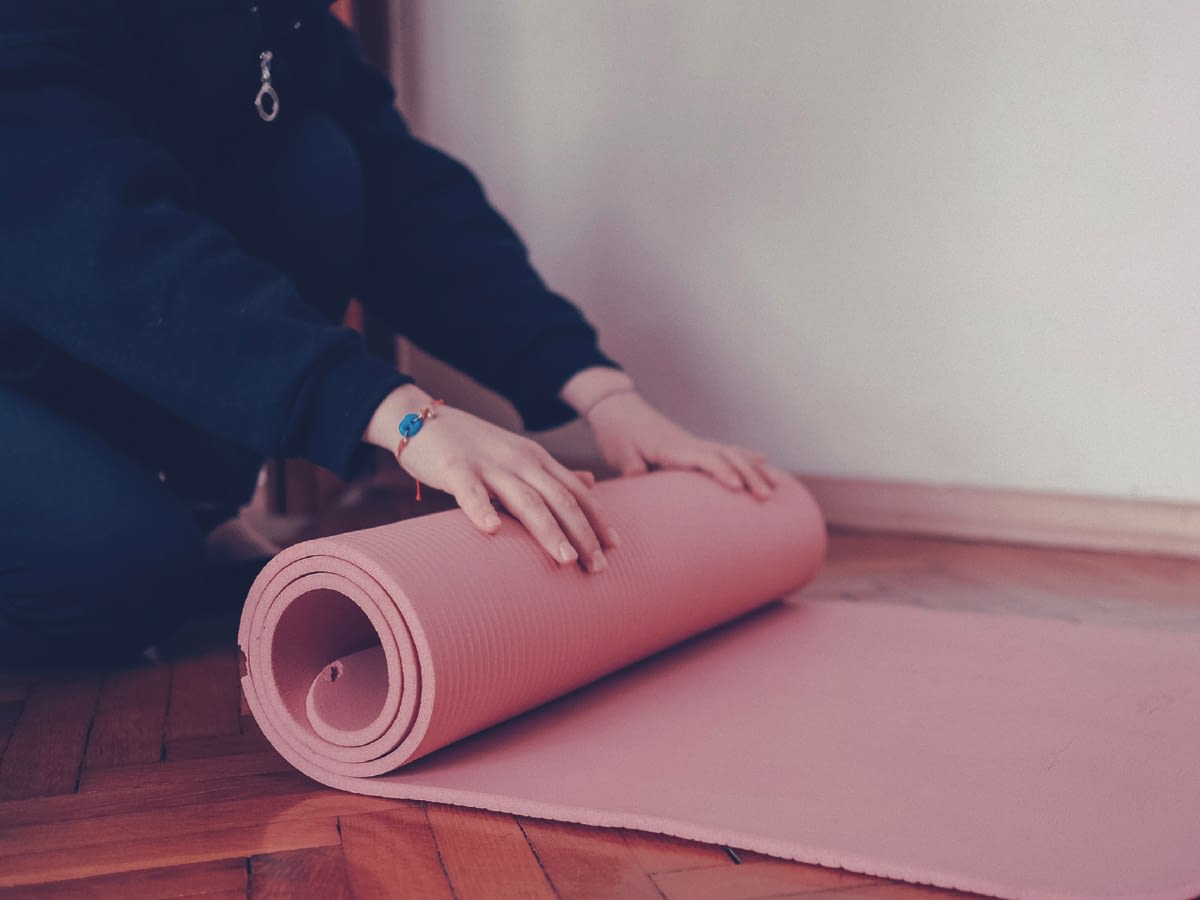
Aubrey invited the dozen or so women who’d signed up for her fall Sacred Wilderness retreat to place their yoga mats on the porch. The lodge we’d occupy the rest of the weekend was tucked in the rolling country hills of North Central Ohio, far from city lights. We stretched out on our mats, draped a throw blanket across our bodies, and looked at the night landscape, barely able to discern the tall pines and deciduous trees in the valley from the shadowed lawn and distant hills.
“This practice is called ‘yoga nidra,’ or yogic sleep,” Aubrey shared. “All you will do is lie in corpse pose and listen—listen to your body, listen to my voice, listen to the night, and breathe.”
In my journey with POTS (an autonomic system disorder—or dysautonomia), I’ve needed to learn what it means to live embodied, or, in other words, to listen for the Spirit of God incarnate within my cells and muscles, to be in tune with what is truly good and real and beautiful to live an abundant life in Christ. I’ve needed to listen to the wisdom of the Spirit urging me to rest. I’ve needed to understand how to live within this temple of the Holy Spirit and tend to it the way one might polish the pews in a centuries-old sanctuary.
If this sounds a little strange, remember, God himself put on flesh. God himself rested. God himself retreated to lonely mountaintops to pray. God himself prepared fish and ate breakfast with Peter lakeside after his resurrection. God himself held onto his scars in his resurrected body and let them tell their story. God himself made himself known to us through an earthly body, formed of spirit and spit, blood and dust.
If we are God’s temples, as Paul says in 1 Corinthians 3:16, what does it mean to dwell here, in our bodies, with the Lord? Surely he speaks even here. Can we listen to our bodies and hear the Lord’s kindness for us—remember, rest, eat, drink, be nourished, heal?
When I attended my first yoga practice years ago, I was a thirty-year-old mother of three training for a half-marathon, looking for stretching exercises to counter the cardio and strength training routine I’d adhered to for the previous nine months. One of the women at my church had started offering a free yoga class on Mondays and invited me to join. Although I was past the point of worrying about whether positioning my body in particular yoga poses might invite demons into me (a fearful season of my faith journey), I had no idea what I was doing. I felt sure everyone in the room was laughing at my incompetence. I spent most of the time jerking my head around, trying to mimic whatever pose my neighbor had struck. I was so out of touch with my body that I might as well have been a disembodied spirit in the corner.
Even as the instructor assured us all that this was our practice and not to worry about performance, I felt terribly awkward. “Relax,” I thought to myself, “No one cares what you look like. No one is watching you.” I took a deep breath and did my best to focus on the instructor’s voice and guidance, gradually settling into myself again.
At one point in that first practice, we were guided into goddess pose, a wide-legged squat with hands in a prayer position at the heart. Then, the instructor invited us into a wide-legged standing forward bend. As I straightened my legs and bent over, laughter bubbled up from my chest, followed by tears. What is happening to me? I thought to myself, surprised by these emotions. Maybe it’s the demons!
Afterward, I told the instructor—one of my best friends—about the emotions I experienced during that part of our practice. She said, “Yoga positions can unlock memories and emotions that our body is holding onto. Listen to your body and see what it has to tell you.”
Back at the retreat, Aubrey let the sounds of night lull us into yoga nidra. I focused on my breathing and worked to clear my mind of the noise I’d left behind and the to-do list waiting when I returned home. I focused on the rise and fall of my chest against my palms, the thud of my heart.
“Now that you’re here, we’re going to focus on one part of your body at a time,” Aubrey said calmly. “Consider each part, bless it, and see if it’s holding any tension still, even now as you recline, and release that tension to the best of your ability. Let’s begin with your toes . . . ”
The second toe on my right foot spoke. You were eight and riding a horse for the first time. The saddle slid loose and you fell off. The horse rolled around on the ground, and in the chaos, it stepped on your foot. I lost my nail. Remember? I remembered. The soft pads of my foot chimed in, Remember when you were in middle school and wondered what would happen if you stepped on the nail protruding from the board in the barn? Remember how foolish you felt, how you hobbled back in the house afraid to confess out of embarrassment? Remember? I remembered.
As Aubrey progressed up our bodies, calling out legs and hips and bellies, all the scars I’d carried told their own stories—Remember when your foot slipped on the pedal of your bike in the dusty heat of summer and peeled the skin away from your shin? Remember the three times the surgeons sliced open your lower abdomen and pulled out living children, how the nerves around that scar are still numb? Remember?
For every body part, a wound, a scar, a story. I lay supine and listened to Aubrey’s instructions, marveling at the voice of my body bearing witness to what we’d been through together all these years. As we left behind each body part, I gave a silent thanks for its memory, its resilience, its healing.
It’s been almost eight years since that retreat. The lessons I had begun to learn that weekend have carried forward to care for me through my long-Covid journey, through the confusing battleground of chronic illness into my POTS diagnosis, and through these last five years of glacier slow neurological recovery.
The Lord has used those years to restore and transform me, body and soul. He has asked me to turn my ear to him and listen to what he has to say, through the fatigue and brain fog, the dizziness and headaches, the light-headedness and thirst. Come to me, all who are weary (in spirit, in mind, and in body), and I will give you rest. Come to me, all who hunger and thirst. Come to me. I am closer than your own breath. I am in your breath. I am your every breath.
I’ve learned that my body has a voice and needs; it is both weak and strong, vulnerable and resilient; and it has a story to tell. Christ and his love dwell within us. He brings these dry bones lying in corpse pose back to life.
—Written by Sarah M. Wells. Used by permission from the author.

2 Responses
Thank you for this post. I have been truly blessed by what is quoted by Sarah M. Wells…”God himself held onto his scars in his resurrected body and let them tell their story.”Jesus’s scars tell the story of how he endured suffering and the torture of the cross for us. He was doing a new thing by preparing a place for us in eternity. His scars remained to be a testimony for those who need to see to believe. Our scars serve the same purpose.
Thank you for sharing your insightful journey with healing and connection.