Our Bodies
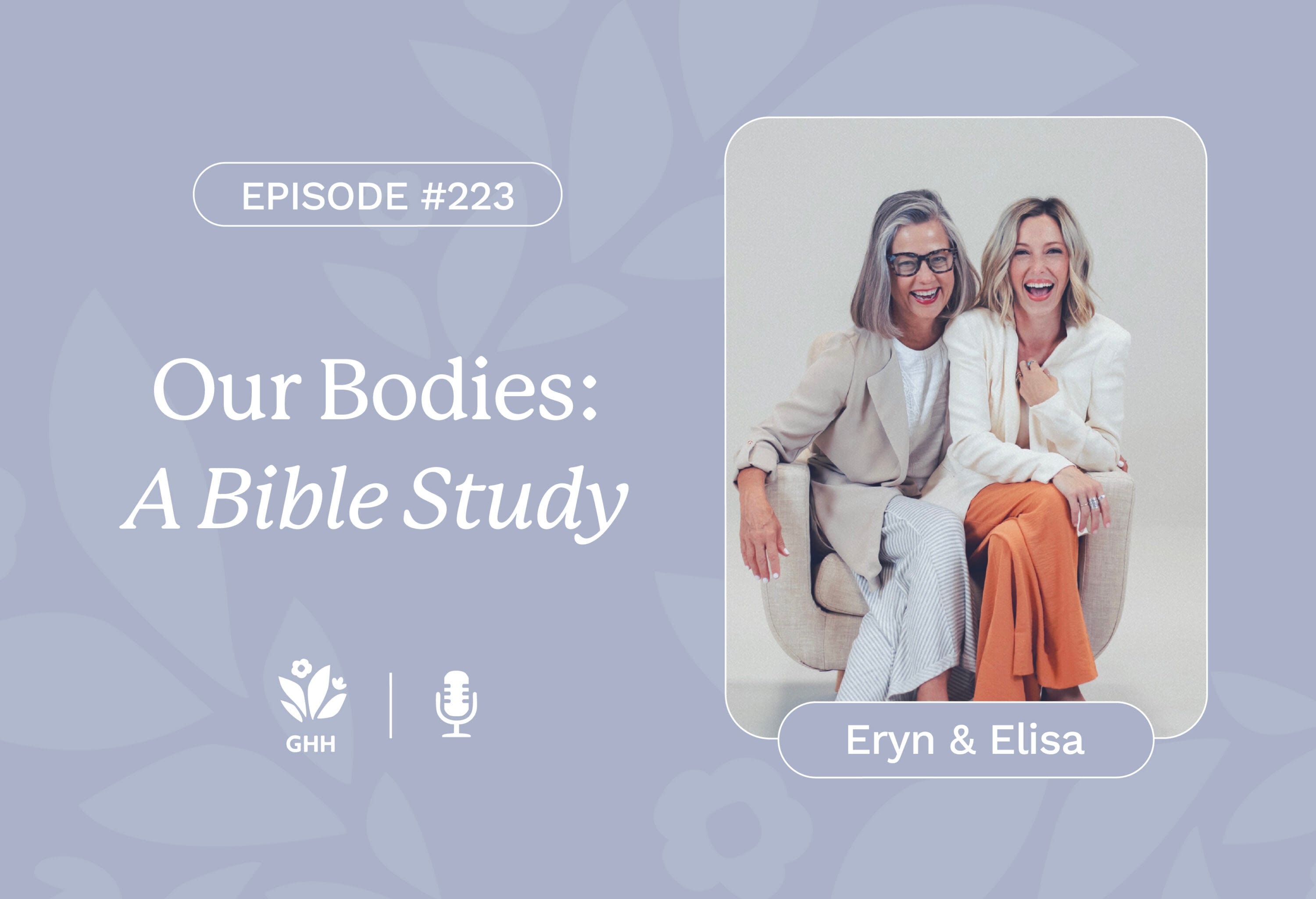
About this Episode
Episode Summary
What Do You See When You Look in the Mirror?
If your first instinct is criticism, you’re not alone. Research shows that 97% of women experience at least one “I hate my body” moment every single day. But what if the mirror could show you something different? In this episode of God Hears Her, hosts Elisa Morgan and Eryn Eddy Adkins dig into one of the most personal struggles women face—body image—and bring it straight to Scripture. Together, they explore what it really means to be made in God’s image and how that truth can interrupt the negative thought patterns we’ve carried for years. This isn’t a pep talk. It’s a Bible study, and it might just change how you see yourself.
Episode Transcript
God Hears Her Podcast
Episode 223 Our Bodies (A Bible Study)
Elisa Morgan and Eryn Eddy Adkins
[Music]
Eryn: “Do you not know that your bodies are temples of the Holy Spirit, who is in you whom you have received from God? You are not your own. You were bought at a price. Therefore, honor God with your bodies.”
[music]
Vivian: You are listening to God Hears Her, a podcast for women where we explore the stunning truth that God hears you. Join our community of encouraging one another and learning to lean on God through Scripture, story, and conversation at godhearsher.org. God hears her. Seek, and she will find.
Eryn: Hey friends, we now have a study guide to go along with our podcast episodes that you can download or print to fill out when you listen. Make sure you get yours on our website to follow along with the episode. Now let’s dive into this conversation.
Elisa: So Eryn, what part of your body do you like the most? You go, oh, I love this part of me.
Eryn: Oh.
Elisa: Mm-hmm.
Eryn: Probably. I really like my nose.
Elisa: Your nose. How cute is that? And why do you like your nose?
Eryn: Cause it’s like, it’s little, but it’s like not like too small. I don’t know.
Eryn: It smells things.
Eryn: It smells things. I like the freckles on ’em.
Elisa: Yes, you have cute little freckles on your nose.
Eryn: Was debating between that or my belly button, because my belly button is a flatty. It’s not an innie, it’s not an outie, it’s a flatty. And when I eat, it becomes an outie a little bit ,and I think that’s funny. What about you? What’s your favorite part of your body?
Elisa: Well, mine rhymes with yours. My…my favorite are my toes.
Eryn: Oh
Elisa: Yeah. Isn’t that funny? I remember in fifth grade or something, somebody…I was at a track meet, and I had sandals on. And somebody looked over and said, “Oh, your toes are so pretty.” And I was so proud. I…I had just, uh, painted them with like this frosted pink 1968, you know, whatever toenail polish. And I felt so pretty and, you know, sometimes still I’ll get a pedicure or I’ll just, you know, sit out on a summer day, and I’ll look at my toes, and I think I like you little toes.
Eryn: Oh, I love that. You do have really beautiful toes.
Elisa: Oh, [laughing] alright…too much information here. Okay, so, alright, so…so now…now we have to say, what part of your body are you less thrilled about?
Eryn: This one’s not as much fun.
Elisa: No, it’s not.
Eryn: I would say my legs.
Elisa: Oh, okay. Why?
Eryn: Because I’ve learned to love them.
Elisa: Mm-hmm.
Eryn: But it’s not my first choice.
Elisa: Mm-hmm.
Eryn: So I think that we can probably…anybody listening probably identifies with that.
Elisa: Mm-hmm.
Eryn: In some body part. I used to be called chicken legs all growing up in school, because my legs, like my thighs wouldn’t touch, and then my knees were bony. And they still are, but they’re not. I mean, I’ve developed into being a woman, but…
Elisa: Mm-hmm.
Eryn: …I see ’em through the lens of that sometimes.
Elisa: Yeah.
Eryn: So like I don’t like to wear shorts. I don’t like to wear skirts unless I’m like going to the lake. I will wear them. I mean, you’ve seen me in shorts and skirts.
Elisa: Yeah.
Eryn: And all the things, but that takes major courage for me.
Elisa: Oh.
Eryn: Because I must like the outfit.
Elisa: It has to be super cute. And you’ve shared before some of the pains of growing up with your body type and adjusting with it. And we all have those. So when, you know, we might be able to scrape up one body part that we sort of like, usually we have like 20 that we’re not as crazy about. And for me, you know, and I’m old [slash] older now, and I have lumpy bumpies where I didn’t used to have lumpy bumpies. And I’m like, what is this?
Eryn: Mm-hmm.
Elisa: What are these age spots? What are these veins on my hands? When you put your hands down, you know, all the blood rushes down there. And Dominic, my, uh, middle grandson will go, “YaYa, why do you have all those wobblies?” Those are my veins.
Eryn: Wobblies? I love that. That’s what he calls ’em, wobblies.
Elisa: I know, wobblies. So there’re some areas that I’m not crazy about. And the reality is, this is where I want to go today. And I love that we could be so straight up, honest with each other. Cause we talk about this stuff all the time in life.
Eryn: Yeah.
Elisa: We may as well talk about it on air. Women especially struggle with our bodies.
Eryn: Mm-hmm.
Elisa: In fact, a Glamour survey of more than 300 women of all sizes revealed that, on average, women have 13 negative body thoughts…
Eryn: Wow.
Elisa: …daily. That’s like…
Eryn: Wow.
Elisa: …one every waking hour. And 97% admitted to having at least one “I hate my body moment” every single day.
Eryn: Wow. And hate is such a strong word.
Elisa: It is.
Eryn: You alluded that I’ve struggled a little bit with my size. And honestly, I used to be like growing up, you shouldn’t feel that way because other women complain about X or you shouldn’t…like so I would, should me. You shouldn’t feel that way about your body…
Elisa: Ah, sure, yeah.
Eryn: …because of…and I think that we all do that to an extent of, I think we do should all over ourselves with how our bodies should look or…
Elisa: Or how we should feel about them.
Eryn: …we should think and feel about the way that they are, but hate. Wow.
Elisa: You know, and it’s interesting too that globally what we think is beautiful changes, you know. Um in some African countries, women are supposed to fatten up before they get married. In some other countries, you know, you’re supposed to have really light skin, and they’ll put this kind of paste on your face. I mean, it just goes on and on about what we think is beautiful versus, you know, it’s…it’s kind of random. But we struggle with it. And I think in Christendom we do as well. You’re not supposed to like your body, you know, that’s just so earthly and worldly and…
Eryn: Mm-hmm.
Elisa: Oh my goodness. So I want to dig today…
Eryn: Great point.
Elisa: …today into what Scripture offers us regarding our bodies, how to view them. And…and maybe just one little pop here for one of us sharing today and participating today will just open a little window in how we view our bodies and…and give us a fresh perspective. I want to start off in Genesis. Let’s turn to Genesis chapter one, and I’m just gonna read this together. I’ll read a verse, and then you read a verse, and then I’ll read a verse. This is Genesis chapter one. We’re gonna read verses 26 to 28. So I’ll start off. Okay, this is in the creation account. “Then God said, ‘Let us make mankind in our image, in our likeness, so that they may rule over fish in the sea and the birds in the sky, over the livestock and all the wild animals, and over all the creatures that move along the ground.”
Eryn: “So God created mankind in his own image. In the image of God, He created them, male and female, He created them. “
Elisa: “God blessed them and said to them, ‘Be fruitful and increase in number. Fill the earth and subdue it. Rule over the fish in the sea and the birds in the sky, and over every living creature that moves on the ground.’” So go back to verse 27. Eryn, read it one more time, would you?
Eryn: “So God created mankind in his own image. In the image of God, He created them, male and female, He created them.” Why does He say He created them twice?
Elisa: Isn’t that interesting? What do you think, Eryn? He created mankind, that’s the general generic word for humans, in His image.
Eryn: Male and female. He created them.
Elisa: Uh-huh, uh-huh. Yeah, I think maybe you’re onto something that He really needed both genders to express His image. This…theologians call this the imago Dei. That’s a Latin term for, you know, the image of God. And it’s hard to contain what that really looks like. But humankind…look, actually, He says it three times. Humankind in His image, in the image of God, He created them. Male and female, He created them. He’s making a big deal in this creation account about humankind are created in the image of God. Now, what does that do? It…it is not just an image like a hologram that you project up onto an…a wall, and you can’t touch it, but you can just see it. The image here is an actual body. In fact, we’re told in other passages from the dust, He created them. You know, from the rib, He created her. He blew [sound effect] breath into and gave life to them. This is a physical body.
Eryn: Hmm.
Elisa: So our physical bodies are created in whose image?
Eryn: In God’s image, our Master, our Maker…
Elisa: Yeah.
Eryn: …our Creator.
Elisa: Beautiful. And that can influence how we view our bodies, right?
Eryn: Yeah.
Elisa: I want to turn to another passage, and this one…I just love this. This is 1 Corinthians, chapter 6 And then we’re gonna look at verses 19 and 20. Now to set the context for it, Paul’s writing to the Corinthians. This is the early church. And he’s dealing with a lot of lifestyle issues. The world is very worldly there in Corinth. He’s talking about lawsuits. He’s talking about sexual immorality, because there were prostitutes in the temple and the what? What? This is kind of wild stuff if you’ve never really immersed yourself in Bible culture, first century culture.
Eryn: Ooh, that’s getting nitty gritty of it.
Elisa: Yeah.
Eryn: Come on.
Elisa: And Paul for sure is talking about, don’t hook up with a prostitute because…well, actually, I’m gonna just pick up a verse that I’m not gonna have us read.
Eryn: Okay.
Elisa: He says in verse 18, “Flee from sexual immorality. All other sins a person commits are outside the body, but whoever sins, sins against their own body.” It’s an interesting thing. Paul wants us to keep our bodies pure of sexual sin. But then he goes on, and he pops it to a bigger picture in verses 19 and 20. Read that. Would you, Eryn?
Eryn: “Do you not know that your bodies are temples of the Holy Spirit, who is in you, whom you have received from God? You are not your own. You were bought at a price. Therefore honor God with your bodies.”
Elisa: Do you have The Message? I wonder what it…how it reads that in that Eugene Peterson paraphrase.
Eryn: Yeah, I do. So let’s see. “Or didn’t you realize that your body is a sacred place, the place of the Holy Spirit? Don’t you see that you can’t live however you please squandering what God paid such a high price for? The physical part of you is not some piece of property belonging to the spiritual part of you. God owns the whole works, so let people see God in and through your body.”
Elisa: That is so helpful. Read that last, last phrase again.
Eryn: “God owns the whole works. So let people see God in and through your body.” I also love what it says…where it says, “the physical part of you is not some piece of property belonging to the spiritual part of you.”
Elisa: Yep. It’s legit…
Eryn: That God owns…
Elisa: …offering itself.
Eryn: …the whole works.
Elisa: Yeah.
Eryn: Let people see God in and through your body. It’s the whole picture, the whole image of God. Okay.
Elisa: That’s right. So track that back. Do you not know that your bodies are temples? That word temples really means the abode, the home of God’s. And then he talks about how the Holy Spirit is in you. The word there is dwells or inhabits you. So the Holy Spirit, God Himself, not just the image of God, God Himself lives where?
Eryn: In you.
Elisa: And so that what? Now can you read that last phrase again? This is at the end of chapter 20. So that what?
Eryn: “So let people see God in and through your body.”
Elisa: This is what absolutely has transformed my understanding of my body that last little bit. Now…now think about it for a second. Tell me what’s on your bathroom counter.
Eryn: I have a vase that I put all my cotton balls and Q-tips in
Elisa: Me too. Okay, and I’ve got a perfume atomizer.
Eryn: And I have this like vitamin C oil that I put…serum that I put on my face.
Elisa: Mm-hmm. And I’ve got some Aveeno lotion that I pump out. But all of those things, all of those items we just described are containers.
Eryn: Yeah.
Elisa: The first thing you talked about is your Q-tips and a cotton balls, and they’re in a kind of a container, so that you can pull off the top and easily access one, right?
Eryn: That’s right.
Elisa: Okay. And my perfume, I pick it up and…and squirt it, spray it on myself to easily apply that perfume.
Eryn: Yeah.
Elisa: These are all containers that give us access.
Eryn: Mm.
Elisa: To the substance inside.
Eryn: Mm.
Elisa: Now take that idea and apply it to our human bodies. We are the temples of the Holy Spirit so that people have access to the God who dwells in us.
Eryn: Yeah.
Elisa: In other words, we are to live our lives in our human bodies so that we ourselves have God living within us, because He bought us with the price. And He owns us, and He loves us. But so people too have access to Him through us.
Eryn: Mm.
Elisa: Suddenly your legs aren’t so weird looking.
Eryn: Mm-hmm.
Elisa: You know, suddenly my lumpy bumps are not so horrible.
Eryn: Yeah.
Elisa: Suddenly, not only are my toes cute, but all of me represents the image of God.
[music]
Mary Jo Clark: While listening to this conversation, have you been thinking that you want more help in reframing thoughts about your body? To continue on this topic, check out Already Whole by Ellen Wildman, a 90-day devotional to help you feel at home in the body God gave you. You can find a link for the devo in our show notes. Now, back to the show.
Eryn: So what can we do, Elisa, to that knowledge of knowing that our body is a temple, but that it is like a…it’s a house, it’s a home for the Holy Spirit to dwell and live in…within us? How do we head knowledge know that and let it go into our heart so that when we go out and about and we’re in spaces where we want people to see who He is through experiencing…
Elisa: Mm-hmm.
Eryn: …just our whole being, our whole works? Because I struggle with the outside noise so much. I mean, it’s everywhere. It’s on social, it’s on the news. It’s our own thoughts. How can we have our head and our heart connect to where we actively walk with that authority and truth…
Elisa: Yes, yes.,
Eryn: …of who God is in us?
Elisa: You know, I’m gonna suggest three things, and I may forget ’em. But anyway, because they just popped all into my mind. But the first one is, I think we look at Jesus.
Eryn: Mm-hmm.
Elisa: John chapter 1, verse 14 says, “The Word became flesh and made His dwelling among us. We’ve seen His glory, the glory of the one and only Son who came from the Father full of grace and truth.” Jesus Himself used a vessel body to walk this earth. He had vessel hands, container hands, if you will, to heal people. He had vessel eyes, he had vessel ears, he had vessel heart. He was a vessel. Jesus Himself became flesh. So I think we start there and remember that, and remember that He took that vessel all the way to the cross, that that vessel was beaten and whipped and tortured, and then stapled to a cross and then died. And then that very vessel, boy, I’m preaching it here…
Eryn: Yeah.
Elisa: …rose from the dead to give us the understanding that that body itself is sacred, and we’re gonna have new bodies one day. So I think we start and continue there. But a second thing, this popped into me and as I was doing a study one day. Turn to Psalm 45. This is a wedding psalm. It’s written about a bride and a groom and about the beauty of them both, Psalm 45. And you’ll see all this beautiful imagery. I mean, the prescript says, “for the director of music to the tune of lilies. “And it’s a wedding song.
Eryn: Mm-hmm.
Elisa: But it’s not only literally for a bride and groom, but it’s also figuratively for the bride of Christ and God. God, the king that we, the church, married. And I’m blown away by a couple of, uh, verses in here. Let’s start at verse 9. If you could read 9 and we’re gonna go down to verse 11.
Eryn: “Daughters of kings are among your honored women. At your right hand is the royal bride in gold of Ophir. Listen, daughter, and pay careful attention. Forget your people and your father’s house. Let the king be enthralled by your beauty; honor Him, for He is your Lord.”
Elisa: What do you hear in there?
Eryn: Well, I love the “pay careful attention.”
Elisa: Mm-hmm.
Eryn: And then “Forget your people and your father’s house.”
Elisa: Mm-hmm.
Eryn: “Let the king be enthralled by your beauty. Honor Him for He is your Lord.”
Elisa: So powerful. So you’re…you’re seeing these women transition from one home to another. And if we see the literal side of the earthly wedding, that’s beautiful. But when we see the kingdom side of us being married to God, we let go of how we’ve been interpreted—chicken legs, lumpy bumpies. And we let go of that. and we allow. Let…there’s a permission being granted to the king. “Let the king be enthralled by your beauty.” You’re not…
Eryn: Yeah.
Elisa: …oh, sort of prettiness. Or you’re not, you know, ickiness and whatever, cute toes and nose and that’s it. No, let him be enthralled by your beauty. And so I think this is the second thing that helps me think about how to apply this in real life, is that can we re-image ourselves the way God sees us? Could we make some vessel vows, if you will? I mean, this is a wedding ceremony, vessel vows that, Lord, I’m gonna give You my lumpy bumpies. I’m gonna give You my chicken legs. I’m gonna give You my 50 pounds extra, I’m gonna give You it. And it doesn’t mean I’m never gonna be healthy. I am gonna be as healthy as I can be, but I’m going to stand before You and let You be enthralled…
Eryn: Yeah.
Elisa: …by the beauty You’ve created in me.
Eryn: Mm.
Elisa: What does that do to you, Eryn?
Eryn: Well, it makes me excited to own my body, I will say.
Elisa: Mm-hmm.
Elisa: I do love that the way the message says, “the king is wild for you.”
Elisa: Oh, read that. Yes, now let’s read that.
Eryn: Well, it says, “Now listen, daughter, don’t miss a word. Forget your country. Put your home behind you. Be here. The king is wild for you.”
Elisa: Mm-hmm.
Eryn: And I love the “be here.”
Elisa: Mm-hmm.
Eryn: And so to me, when I hear like, be here, it’s like just embrace the presence of yourself, of your…of your body, whatever it looks like–big, small, wide, skinny, whatever it is.
Elisa: Mm-hmm.
Eryn: Just be here, and just know how wild He is for you.
Elisa: Mm.
Eryn: When I hear the word wild, I just…it gives me a picture of just like, He’s just wants to scoop me up. And…and some people don’t want to be scooped up. But…
Elisa: Right.
Eryn: …but I would love for the Lord to scoop me up and be like, I am so excited for how you are made.
Elisa: Yes, yes.
Eryn: Honor it, you know, honor how I made you.
Elisa: You are good. That’s what He said after every creative act except for the…the one where man was alone, and He wanted to make an…a woman to be with him, cause it wasn’t good. Everything else is good, good, good. You were good. And I think that leads to the…the third practice. And this is gonna sound weird for some people, but I think it’s really important personally, and I’ve been practicing it. But it’s to look at your body. Maybe you just look down at your toes, or you look at your elbows, or you know, you look in the mirror ,and you stand before your body. And you give thanks to God for each aspect. Thank You, God, for my natural-colored hair today that used to be brown, and now it’s got this strange blonde thing in it that looks kind of gray. Thank You that it’s seen so many years. Thank you, God for my…my mouth and the fact that I can continue to speak for You. Thank You for my hands with their wobblies and all the things I’ve been able to carry and touch and hold and bring close to me and release at times.
Eryn: Yeah.
Elisa: Thank you, God, for me, as I had a…an…a broken arm. Thank You for Your healing work going on in my shoulder. Thank You that You’re knitting together broken bones. When we do that, when we stand before ourselves and…and bring that all to God. And…and I’ve…I’ve prayed this with dear friends who’ve had cancer. I’ve prayed this with people who have had neuropathy after cancer. I’ve prayed this with people whose brains have…are suffering with depression. When you begin to thank God for that aspect of your vessel, that container that holds the Spirit of God in this world, to give us access to the Holy Spirit and others access to Him, whew. It really changes everything.
Eryn: Gratitude. I love that you are challenging us to look in the mirror and to say thank you to the things that we aren’t necessarily thankful for, that we wish we could change. Research says that gratitude really does help heal parts of us. And so looking in the mirror and saying, “I’m grateful, and thank you for that one hair. I’ve made it this far.” But then I love that you touched on there are certain things that are going on inside our bodies…
Elisa: Mm-hmm.
Eryn: …that we wish we could change, like the depression, like the anxiety, like the illness that you may not physically see. How do we talk to ourselves to those things? How do we fully not allow those to be our labels?
Elisa: Mm-hmm. If you want, you can kind of divide up the vessel part of who we are, which is our physical body. That’s what we’re talking about today, and realize there are, I don’t know, several aspects of it. You know, maybe it is our flesh, and it’s things like disease, or it’s things like weaknesses that we go through, or diminishments that we face as we get older in life. Okay, maybe it’s our brain and…and our…it’s not cool in some seasons of society for women to be smart. You know, we’re supposed to be dependent and needy. And so when you see women with high IQs, especially at some of the movies we’ve seen like Hidden Figures or you know, some of those where women had to break out and be freed to use their God-given intellect, or the flip side of some woundings, depression or mental illness that have happened there. Or maybe it’s our muscle, you know, I love to watch women athletes or just women who are so comfortable with their strong bodies like Simone Biles. All of these aspects are our vessel, and we all have work to do in every one of those aspects. And that work is important in our vessel vows. God, I give You this body, I pledge it to You. I allow You to see the beauty of it. Help me to embrace what You see. Show me where I need to grow. Show me where I need to be more healthy, both in my mind and in my body. Show me how to make a temple an abode where You are comfortable to dwell with me. Because I want You in my life.
Eryn: Just like that Scripture, it’s the spiritual and the physical that comes together.
Elisa: Mm-hmm. You know, just as Jesus really modeled that for us, “the Word became flesh and dwelt among us.” You know, His Spirit comes into our flesh. And we dwell among others here in this planet as a physical representation of our king. As we close, Eryn, I just…I think it’d be cool if you and I both pray…
Eryn: Okay.
Elisa: …for everybody listening and just…just pray what comes to mind. And we’ll seal this vessel conversation, this conversation about how we contain God’s Spirit in our physical bodies.
Eryn: I’ll start and you close.
Elisa: Okay.
Eryn: Oh Lord. I just love that we can come to You with our raw thoughts, how we feel, and what we think. And I pray for the woman listening right now that may feel shame about how she’s talked towards herself. Maybe she’s said some really unkind things this morning or this evening or this afternoon. And she just feels really heavy about it. She doesn’t know what to do with it. And maybe the thing that she’s said she feels is true and…and she feels heavy about that too. I just…I pray that You will…will hold her and quiet the shame. I pray that Your voice and how wild You are for her will be so much louder than any lie, any shame, any negative talk towards herself, whether it be the physical parts of her or the spiritual parts of her that she was talking about and shaming. And so I pray for protection over her thought life. I pray that You will be her protector, and I pray that You’ll be her guide. Guide her in the thoughts that You want her to think about herself, because we know that You are so loving and so wild for her, and it’s in Your heavenly name. We pray.
Elisa: God, I agree with that. And as we’re praying, something else is coming to mind. And that’s the reality of scars that our bodies bear, the beautiful stretch marks from creating life, and Father, the more horrific wounds that we’ve endured at the hands of others or at our own hands or through no fault of anyone, just life. And I pray, Lord, for those who are healing from brokenness, God, that You would direct each one to the help that’s needed, that You provide and protect, and bring them along. Lord, brokenness is such a huge part of Your broken world. And God even that Lord, You can redeem. And I pray You would continue that redeeming work in our lives, that we would thank You for that process where scars form over wounds, where new skin is created so that new life can be experienced. We give ourselves to Your understanding of Your Word. Thank you Holy Spirit for dwelling in us. Come Lord Jesus, in Your name, amen.
[music]
Elisa: Well, friends, be sure to check out our website to subscribe to our email list. Read the newest blog article, or check out the God Hears Her books and devotionals. Find all that and more at godhearsher.org. That’s godhearsher.org.
Eryn: Thank you for joining us, and don’t forget God hears you. He sees you, and He loves you because you are His.
[music]
Elisa: Today’s episode was engineered by Anne Stevens and produced by Jade Gustman and Mary Jo Clark.
Mary Jo Clark: We also want to thank Nicolette and Anna for all their help and support. Thank you both.
Eryn: Our Daily Bread Ministries is a donor-supported, nonprofit ministry dedicated to making the life-changing wisdom and stories of the Bible come alive for all people around the world.
[music]
Eryn: God Hears Her is a production of our Daily Bread Ministries.
Show Notes
- “We are the temples of the Holy Spirit so that people have access to the God that dwells in us.” —Elisa Morgan
- “I am going to stand before You and let You be enthralled by the beauty You have created in me.” —Elisa Morgan
- “Just embrace the presence of yourself, of your body and whatever it looks like: big, small, wide, skinny. Just be here and know how wild He is for you.” —Eryn Eddy Adkins
Links Mentioned
- Already Whole by Ellen Wildman
- Watch the episode on the God Hears Her YouTube channel
- Share Your Story
- God Hears Her email sign-up
- Subscribe on iTunes!
- Elisa’s Instagram: elisamorganauthor
- Eryn’s Instagram: eryneddy
- Vivians Instagram: vivmabuni
- Our Daily Bread Ministries Website
Bible Verses:
Related Episodes:
- GHH Ep 118 – Reimagining Age
- GHH Ep 195 – Created in God’s Image with Ellen Wildman
About the Guest(s)
Eryn Eddy Adkins
Eryn is the founder and CEO of So Worth Loving, a lifestyle clothing brand. Since starting in 2011, she’s grown her company to include customers in all fifty states and in thirty countries, and the company is still going strong. She and her work have been featured on CNN and MSNBC, as well as Southern Living and Atlanta Magazine. This creative enjoys oil painting and singing, and she’s even had her music featured on MTV and VH1. Eryn is also an author and a speaker, and she calls Atlanta home.
Elisa Morgan
Elisa is an international speaker, an author for God Hears Her and Our Daily Bread, and a co-host of Discover the Word. She has authored over twenty-five books on mothering, spiritual formation, and evangelism, including The NIV Mom’s Devotional Bible, The Beauty of Broken, Hello, Beauty Full, and When We Pray Like Jesus. For twenty years, Elisa served as CEO of MOPS International. She is married to Evan, and they have two grown children and two grandchildren who live near them in Denver, Colorado.
Comments

More Episodes

Get Connected
Sign up to get early access to new book releases, podcasts, blog updates, and more!