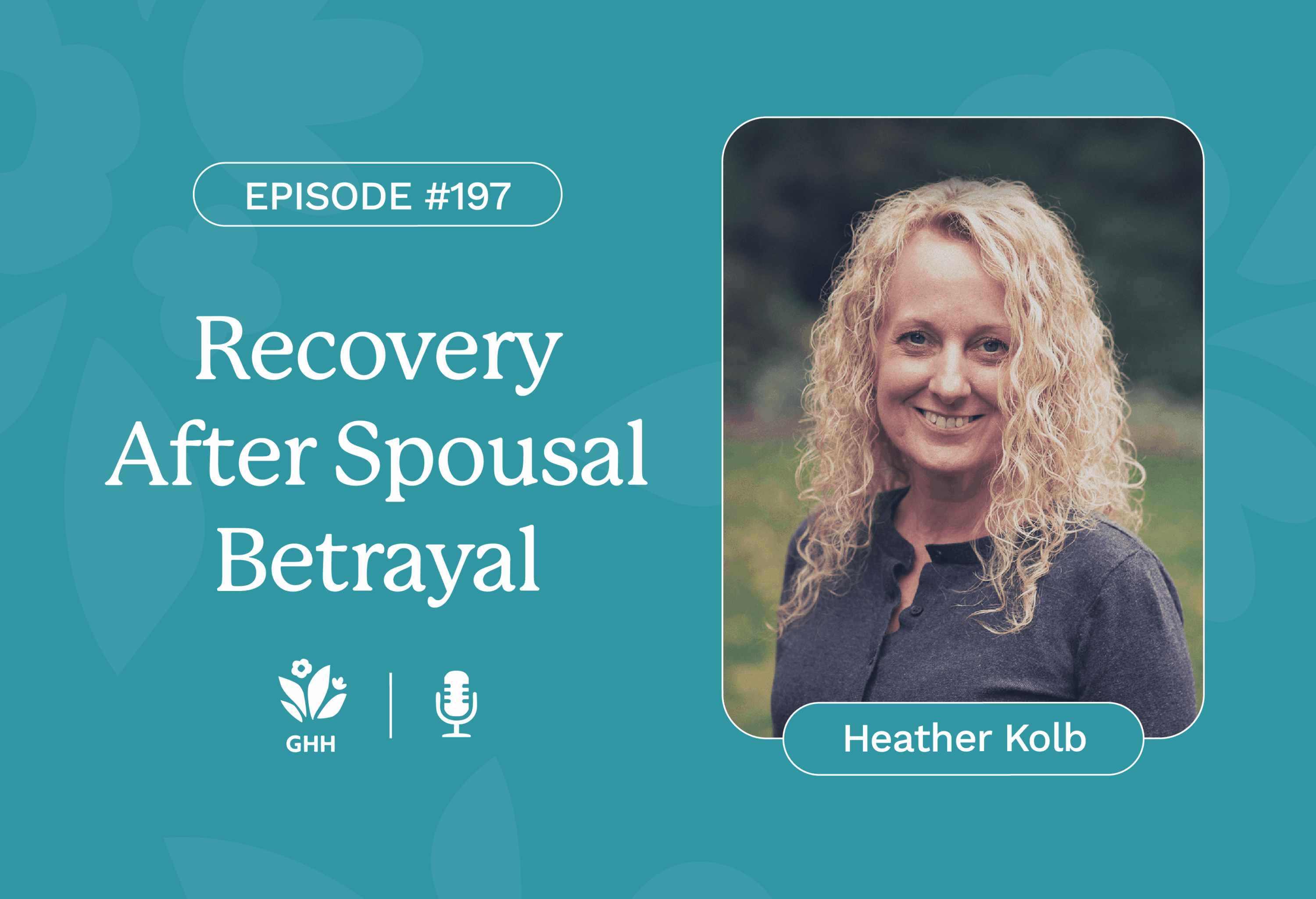
Recovery After Spousal Betrayal
About this Episode
Episode Summary
When was a moment in your life when you felt betrayed? Heather Kolb was in the thick of parenting young children when she found out her husband was being dishonest with her and battling sexual addictions. Scared and heartbroken, Heather stepped away from the church and managed things on her own until she found Pure Desire Ministries. Join hosts, Elisa Morgan and Eryn Eddy Adkins, as they learn Heather’s story and discover how we can recover from patterns of addiction during this God Hears Her conversation with Heather Kolb.
Episode Transcript
God Hears Her Podcast
Episode 197 – Recovery After Spousal Betrayal with Heather Kolb
Elisa Morgan, Eryn Adkins & Vivian Mabuni with Heather Kolb
[Music]
Heather: When discovery or disclosure happens, they’re walking into the middle of a story. You know, they don’t have the beginning of the story, because for most partners, they have no idea that this has been part of their husband’s life or their spouse’s life, and so, they’re walking into the middle of the story.
[Music]
Vivian: You are listening to God Hears Her, a podcast for women, where we explore this stunning truth that God hears you. Join our community of encouraging one another and learning to lean on God through Scripture, story, and conversation at godhearsher.org, God hears her. Seek and she will find.
Elisa: Hey there. Before we start this conversation, we wanted to mention that we’ll be discussing some adult things regarding love and sex addiction. So, please be mindful if there are usually kiddos around you. Okay. Now, let’s get into our conversation with Heather Kolb.
Eryn: Elisa, I’m going to read to you who our guest… what she is certified and specialized in because it’s amazing.
Elisa: Wow.
Eryn: It’s inspiring. So…
Elisa: Cool.
Eryn: She is certified Pastoral Sex Addiction Professional through the International Institute for Trauma and Addiction Professionals, and she has been trained in the multidimensional partner trauma model through the Association of Partners of Sex Addicts Trauma Specialists.
Elisa: That’s a lot. Eryn, that’s a lot.
Eryn: I thought I’d share some of her background and what she specializes in because for those that are listening, whether you know somebody that has experienced sexual addiction or you’ve been in that journey yourself… you know that it’s… it is multifaceted, and it takes a very resilient person to be able to speak on this topic,
Elisa: And we want to be so sensitive to everybody listening… you may not even know what we’re talking about, and you may be deeply wounded and scarred from the reality of it. And we want you to know you’re safe here. We’re with you.
Eryn: That’s right. So, welcome Heather to the God Hears Her podcast.
Heather: Thank you so much for having me here.
Elisa: Yeah. I mean, what bravery, just to even be trained in this, but then to…
Eryn: Yeah.
Elisa: … be willing to chat about it is awesome, Heather. Tell us a… a little as we get into this. What’s your walk with God like? How did you come to know God?
Heather: I came to know the Lord at five years old, because I was raised in a Christian family, so I was churched my whole life. My parents are first-generation Christians, and so they were not raised in. Christian environments, and they will even testify that there was a lot of trial and error with that. And so, I grew up in the church. In high school, I really kind of started to push against my parents’ boundaries and their beliefs, and instead of being compliant to just do what I’m told to do, I started pushing back and saying, well, why… why do we believe this? Why do we have to do this…?
Elisa: That’s awesome.
Heather: … Why do we have to go to church three times a week? What… you know? And I think that for me, that was really the beginning of me not only searching for myself why I believed what my parents had taught me, why I even believed there was a God, who was Jesus. I honestly believed that I was saved from the time that I was five years old and… and prayed that salvation prayer, but I really think that it was more like my junior year in high school where I took ownership of my faith, where I decided that, okay, this… this is going to make sense for me. This has to make sense for me in order for me to choose to live this in my adult life.
Elisa: Yeah. Relate to that so much, Heather.
Eryn: So, walk us through what happens next in your life, Heather.
Heather: I got engaged young and got married young…
Eryn: Okay.
Heather: … And so, didn’t go to college, I didn’t do some of those other things that people do. I got married, and then after a few years we started having kids, and I have three sons. For the most part, when they were young, I was a stay-at-home mom until our marriage was unraveling quickly, and not really knowing how to balance that because my life felt out of control and yet I’d been doing all of the things that I was taught to do in the church…
Eryn: Yeah.
Heather: … You know, I’d been praying, and reading my Bible, and ,you know, waiting for God to deliver me from this unbearable situation, and it happened, but it didn’t happen the way that I had prayed for it to happen…
Elisa: Yeah.
Heather: … because our marriage ended with my first husband. And so, then I had to figure out, okay, now what… what does it look like? And that was, I think that when you ask about, you know, my faith walk and how I was raised, I think that that time, that season, was really pivotal for me, because we had been in the church, and we looked like the perfect family, and we looked like these people could never have the problems that they had, and yet…
Eryn: Yeah.
Heather: … when everything came out, you know, I just kind of shrunk away and left the church, and lost friendships, and lost relationships, and so, I think that there was a season in there where my walk with God was really great and really solid, but my walk with the church or my willingness to be involved in the church, who had hurt me, was strained…
Eryn: Yeah.
Heather: … And so, it took me probably a couple years before I was willing to step back in to church, willing to risk that, because I think that there’s some risks sometimes when you’ve been hurt by the church that, okay, people are not evil…
Eryn: Yeah.
Heather: … this is God’s bride, and I had to really reconcile within myself that, okay, this is something that I need to get over, that I need to walk through…
Eryn: Yeah.
Heather: … to be able to have a relationship with God that comes through the church.
Eryn: Thank you for sharing that, Heather, just so openly that that’s part of your story in walking through an unraveling in a divorce. I am curious to learn, with the unraveling, is that something that at the time that you knew it was unraveling or were you able to see that in retrospect looking back?
Heather: Yeah, so, I knew in the midst of it that it was unraveling, but I didn’t know all the variables involved in that story, but I knew for myself that I felt like I didn’t have control, and I developed an eating disorder in that, and fairly serious eating disorder, because by the time that I was still married, but I had gone to the doctor about something unrelated, and that doctor, she was just in our small town and she said, you know what? You are about to cross a line that you might not be able to recover from.
Elisa: Wow.
Heather: … You either need to go inpatient to an eating disorder clinic for three months, or if you voluntarily go into counseling and start next week, and I think counseling saved my life, honestly. Yeah. So, to answer your question, yes, I knew. I knew that it was unraveling. I thought that I could control it, which I couldn’t because at the time I met with that doctor, I was thirty five years old and I weigh eighty eight pounds, and I was starving myself to death.
Elisa: Oh wow.
Heather: You get to a point where your brain is telling you these messages that make sense to you in the moment, and are trying to protect you from what you’re enduring, and yet it ended up hurting me…
Elisa: What was it that was out of control that you couldn’t control in any way?
Heather: So, I don’t have all the answers to that. I know that there was some emotional abuse in the relationship. I know there was pornography use in the relationship. And I know that my husband was leaving town every week, and yet when I found out he wasn’t going where he told me that he was going, that’s kind of where things really escalated. And a lot of those things, I don’t have answers to those questions even today.
Eryn: I really respect that, Heather. There’s parts of my story that I wish I had answers to, and I don’t have any closure on, but I do know that God held me through even me making bold decisions that maybe other people disagreed with that I should be making. There was something in my gut that knew to make a choice that would be a healthy choice for me in spite of other people’s opinions. God doesn’t want you to endure abuse and create more trauma in your life for the sake of making sure everybody feels okay about yourself.
Elisa: Yeah. That’s not what obedience looks like, right? Yeah.
Heather: Right.
Elisa: So, you’re now a… a professional in helping people with sex addiction, so… there is a definite connection in your story to how you serve today. What is your work and… and how has it shaped you?
Heather: Working at Pure desire… I have been here for almost ten years, and I started with their speaking team. After I got a divorce, I actually went to college for the first time. So, I was thirty five years old and went to college, and then got a bachelor’s degree in psychology, and have a master’s degree in criminal justice and criminal behavior.
Elisa: Wow.
Heather: My education had a strong neuroscience foundation, which I’m so thankful for, and I love the fact that the more that we understand what’s happening in our brain, it helps us to explain our behaviors. It’s the why. So, I was always that why kid, and for me, that’s what helps with this. So, when I went to the Pure Desire Conference, met Dr. Ted, and then at the time they were looking for somebody to teach the neuroscience, and he had kind of, not wrestled with this, but in his conversations with God, he knew that he couldn’t find a pastor, because a pastor would want to spiritualize the neuroscience and it would ruin it, and so, he then felt like God was saying, okay, why not Heather? When I went to that initial conference where it was the first time that I’d ever heard somebody take science and statistical data and lay it over a foundation of biblical truth. And that’s so much what we do at Pure Desire.
Eryn: For those that don’t know what Pure Desire is, would you share what Pure Desire is?
Heather: Yeah, so, we are a nonprofit ministry, that we help people who struggle with sexual addiction or compulsive sexual behaviors and betrayal trauma, and we offer a group program where a lot of people can get into our groups, whether or not they’re the person who struggles or they’re the betrayed partner, and they can find healing. However, we find that of those people who get into group that probably around thirty percent need something that’s a little deeper. And so, we have an entire clinical program, and we have, I think, almost twenty clinicians that meet with a couple who are struggling. And we also have individual counseling as well. And then we create all of our products that we use and ship them out of this very building.
Eryn: That’s awesome. When we come back, Heather will share with us the neuroscience behind addiction. But first, let’s pause and hear about this little special deal.
[Music]
Elisa: Looking for a tell-it-like-it-is Bible study to do with your friends? Well, Unshakeable Moxie might just be what you’re looking for. Think of it more like a mini retreat. Cozy conversations where you can be completely honest about your hurts and hardships. Through this six-week study, you’ll be comforted by countless Scripture passages that remind you how life’s answers will always be found in the loving arms of Jesus. Get a copy for you and gift one to a friend with our special BOGO deal. You can find a link for that in our show notes.
Eryn: Now let’s get back to our conversation with Heather Kolb.
Elisa: Why do people become addicted to porn? What are the causes? What drives an addiction?
Heather: Yeah, so, there’s a lot of variables that could be included in this conversation, but one thing that seems to be very consistent is that there’s some kind of trauma that has happened in a person’s lifetime. Another thing, too, to remember about trauma is that it’s not necessarily what has happened to us, it’s how it made us feel. And so, those feelings technically are the things that drive the addictive behaviors. A lot of times when I teach, I talk about the different parts of the brain, and so, how the amygdala, our emotional center in the brain, is tied with our hippocampus, which is all about memory. And so, something that happens to us, regardless of our age, and most of the time it’s when we’re children, but if you can imagine that something happens that’s beyond our control, and in that moment our brain captures everything about how it’s making us feel. It captures all the details of what happened, and it stores it together in our brain.
Eryn: Wow.
Heather: And a lot of times it is… typically the root of our addictive behaviors are tied back to an initial trauma or a traumatic experience. But what also happens is that then we develop this way of thinking or this mindset that says, when I feel this way, when these things are happening to me, because they’re going to kind of elicit this familiar feeling, then I need to find a way that I can soothe myself, that I can provide comfort to myself, to make myself feel better, even if it’s just in the moment. And so, I know that we get a lot of questions from, well, from both the people who struggle and from betrayed partners, is that why pornography? Why sex addiction instead of, you know, video gaming, or food, or something else, because all of those kind of things are addictive behaviors. But it is interesting, what would kind of create a condition for a person to choose porn and masturbation, or to choose acting out or compulsive sexual behavior, instead of food, and it isn’t… I’m probably way oversimplifying… how this all plays out, but what we find a lot with people who come to us for help, especially people who struggle, they might be able to find sobriety from acting out within, like, sixty to ninety days, but yet that mindset, that condition, still is there. And so, a lot of times what we see is that then they become… then they compulsively exercise or then they start shopping online, or then they go to social media, or then now food becomes a thing and they gain all this weight, because you haven’t dealt yet with the core, and that’s another reason why sometimes the healing process takes so long, is because a lot of us who struggle with an addictive-prone personality, we don’t just have one thing, and once we find sobriety in one thing, then we kind of still have to go through or sift through those other behaviors, because we still need to find what’s the root, what is it that is driving those behaviors, and the root is powerful.
Elisa: So, how do you help somebody get to what the root is, and yeah…
Eryn: Yeah. How do you find the root?
Heather: Yeah, so, in our groups, our curriculum is designed for that. It is biblically based and clinically informed. So, it’s going to have, you know, Scripture, and stories, and talk about Jesus and, you know, His love for us. But then it’s also going to have some tools in there to think through some of the things that really, that we’ve been wounded, the ways we’ve been wounded throughout our lifetime. And sometimes it even starts with identify some… some of our, like, core messages. So, core message for me is that I’m not enough, that I’m damaged goods, that I’m broken. You know, that there’s something wrong with me. And so, even if you start to introduce that language, helping people identify, okay, what are those core messages, the negative core beliefs that you have about yourself, and then to train them to pay attention to when those are showing up, because a lot of times, I know for me, when life is going sideways, it’s easy for me to pull, I mean those core messages, they rise to the surface…
Eryn: Yeah.
Heather: … But when you start to experience, like, some really great things, like maybe you get a promotion or you get a raise or something, and then in that moment the core message is there as well. Then those are the times where you really want to pay attention because our core message, which a lot of our curriculum would describe as, you know, the lies that the enemy tells us about ourselves, that… that are going to be the things that separate us from God and others, that those are the things that we need to find out the why about so that then we can find healing in those areas.
Eryn: Yeah. The betrayal of learning about somebody having a porn addiction was devastating to learn, and I’ve walked with a few friends that have gone through that with their husbands. You’re always met with either you rationalize it, or there is, you know, well it’s just porn, so it’s not really, like, that’s not infidelity. What are some thoughts or things that you’ve learned, whether it’s your personal journey or observing families, that you would maybe give some comfort to a woman that’s experiencing that maybe that can help her feel less crazy when she’s experiencing these conflicting messages?
Heather: Yeah, for sure. You know, it’s interesting, in our curriculum we talk about what happens to a betrayed partner’s brain when discovery or disclosure takes place. And I think one thing for partners to remember is that when discovery or disclosure happens, they’re walking into the middle of a story. You know, they don’t have the beginning of the story, because for most partners, they have no idea that this has been part of their husband’s life or their spouse’s life, and so, they’re walking into the middle of the story, and the part of our brain that I talked about, the amygdala, that emotional center of the brain, which part of its role for us is to keep us safe and search our environment for danger, for our survival, right? And so, for partners, that immediately kind of goes offline because not only are they faced with something they’ve never experienced before, this pain, and this shame, and the devastation that happens to them in their soul…
Eryn: Yeah.
Heather: … and they kind of find themselves not only spinning, but trying to make sense of what they just learned, trying to think about what their future is going to look like, trying to think about in the present, what does this mean for me today, and it’s kind of happening simultaneously. Like, all of it is happening at once…
Eryn: Wow.
Heather: … And I know that I have talked to partners who say, you know, when they learned about it, that they just couldn’t even function. You know, their husband would leave for work in the morning, and they’d be sitting on the couch in this one position, and he would come back eight hours later, and they were still in that same position, and just, like, numb.
Eryn: Is that numb or is that depression, or is that… is that anxiety?
Heather: All… I think it could be all of those things.
Elisa: It’s like, what? How… how could I be so oblivious? Or, how could I not be enough? Or, why wouldn’t they trust me with this need? Or, I’m just an idiot…
Eryn: Yeah.
Elisa: … How could I live through this? So, there’s a lot of self-condemnation. And a lot of overarching self-judgment, and then of course the winner, shame, shame, shame.
Eryn: Yeah, yeah.
Elisa: Right? Is… Is that… that’s what I’m hearing.
Eryn: And you also feel like you can’t measure up to anybody that’s on a screen physically or sexually…
Elisa: Okay.
Eryn: … too. So, there’s also the thoughts of, why couldn’t I be, again, going back to that word, enough, why am I not enough? Something that was really hard for me is to understand the wounding and the trauma in somebody else’s life, that I’m entering into the middle of the story. I love that you use that, Heather…
Elisa: Yeah, yeah.
Eryn: … because for me, it felt like I had known this person for a long time, so I was part of the story, I wasn’t in the middle of it. And you do feel like a fool. How could I not see the signs? How could this person lie to me? How could… all of those types of feelings, and the person that’s pursuing those acts are also having their own shame thoughts. So, it’s really a shame storm…
Elisa: Yeah. Yeah, yeah.
Heather: Yeah.
Eryn: … of everybody shaming each other and themselves.
Heather: I know.
Eryn: Heather, what would you say is the difference between regular counseling, regular, like, family therapists and betrayal trauma therapy. I didn’t know that there was a difference… between the two of specializing in something.
Heather: Yeah. There is a difference and a lot of counselors who have their education in, like, family systems or something like that, like, marriage and family counseling, they might not necessarily have any training in dealing with sex addiction and betrayal trauma. And so, that’s really what we encourage for people who are in this unique situation, is that they go to somebody who has this specialized training, either through ITAP or through APSATs, but just so that they’re getting really good information about what this looks like in the relationship, and how to help the couple find healing, because it is… it’s unique. It’s something that I know that a lot of mental health professionals, they don’t necessarily have that specific type of training. They might have training in addiction, you know, that kind of thing, but sex addiction is kind of a different beast, so…
Eryn: Yeah.
Heather: … we usually would recommend that people find somebody who has this type of training just so that they know what’s happening. Because a lot of times partners, they’ll go to just some other mental health specialist, or they’ll go to a pastor at their church, and the advice that they’re giving does so much damage because they haven’t been trained. So, they’re telling her, well, maybe you just need to have sex with your husband more, or maybe…
Eryn: Yeah.
Heather: … you just need to forgive him, or maybe you just need to not be so demanding or controlling, and that is just wounding the partner again and again.
Eryn: Yeah.
Elisa: Is that some of what you went through when you needed to leave church for a season? Were you getting that kind of advice?
Heather: I was, yeah. I got a lot of the, you know, submit, he’s the head of the family, he’s the decision maker…
Eryn: Yeah.
Heather: … and there was still something inside of me that kept telling me, something is wrong with this system. Something is wrong. And even during mediation, cause we did do some mediation with a pastor for a little bit, but even with that, my ex-husband, his response was, well, how can I lead if she’s not following? And it’s like, dude…
Elisa: Wow.
Heather: … you’re leading has nothing to do with me following.
Eryn: Right. There’s a trustworthiness that has to happen…
Heather: Right.
Eryn: … yeah. Have you seen spouses not want to see the growth and impact, because they want to continue to punish out of hurt and pain and betrayal.
Heather: Yes. Typically the person struggling is the one who gets into group first, that seems to be a very common thing, even if it was the betrayed partner who found the group and told her husband, you’re going to this group because if you don’t, then I’m going to leave you. But then a lot of times they’re angry and they’re hurt, and they’re thinking, why do I need a group if I’m not the one who did this? I didn’t even do this, and now I have to be in this group...
Eryn: Yeah.
Heather: … And so, Dr. Barbara Steffens, who is wonderful, she’s the… one of the founders of APSATs, and she will say, you know, welcome to the sorority you never planned to join…
Elisa: Yeah.
Heather: … You know, because it’s just like, all of a sudden we are in this place and now we need healing still for ourselves, but yet that anger is still there. And so, even if their spouse is doing the work, it still is going to take time because she found out in the middle of this, and now she’s had to think back through their entire relationship, and think, was any of this the truth? Was this all a lie? And so, it’s going to take a while for her to get to a place where she’s not angry, and she’s not hurt, and… and she’s not feeling that shame every single waking moment.
Eryn: I know we’ve referenced men experiencing sexual addiction, and it may be more common, but have you seen women struggling with sexual addiction and porn addiction as well in your recovery groups?
Heather: Yeah. We have a group specifically for women. We have… our unraveled group is for women who struggle with love, sex, and relationship issues, because we don’t just call it, you know, like sex addiction or porn addiction, because a lot of times with women, it’s broad. It has to do more with not necessarily having a sex addiction, but maybe having a love addiction or a relationship addiction, something like that.
Eryn: What’s that look like?
Elisa: Yes.
Eryn: Is that like seeking attention, or how would that be defined?
Heather: Well, it’s even like being in love with love. The idea of being loved, and a lot of times when you talk with women, they’ll tell you that I was willing to cross these sexual boundaries because I really just wanted to feel love, but I only feel loved if I give them sex, you know? And so, it…
Eryn: Gotcha.
Heather: … really is more about the intimacy, and the feelings and the emotional connection, and… more so than sex, but yet sex is going to get me to what I want.
Eryn: That makes sense. That’s really helpful.
Elisa: Can we be cured? Is it possible to really recover from these addictions? And is it possible for marriages to be healed from them?
Heather: Yes, it is possible. It is… I don’t know if I would ever use the word cured just because I think that this is something that a lot of people who get into groups, and into counseling, and they start their recovery journey, there’s a moment where they realize that, you know what? This is something that I’ve struggled with my whole entire life, even if it had different versions of my addictive acting out, but in order for me to maintain sobriety, and to stay in recovery, then I’ll probably be in a group the rest of my life, because it really is one of the things that allows them to be fully honest and fully known in this safe community without judgment or condemnation, and really does help to support them in their recovery journey. Like you said about marriages, yes, definitely. Marriages survive. We have a lot of stories of healing that we share at different times through our Pure Desire podcast or these other resources, but it is possible, and a lot of people, especially in our counseling program who go through that as a couple, they end up finding out that their marriage is so much better than they ever thought it could be, but it does take time and it’s work. A lot of work.
Eryn: It’s a narrow road. Are there some words that you would want to speak over the woman that’s listening, maybe she’s discovered some news, whether it’s about herself or somebody that she’s in a relationship with or married to, are there any words that maybe you could share with her?
Heather: I would say that the best way for you to find healing for yourself, not even for the marriage, because that decision might come later, is that for her to find safety, and stability, and reclaim her identity in Christ, would be for her to get into a group specifically like a Betrayal and Beyond group, because you’re going to be in a group with other women who are walking a very similar road to healing, and I think that that support that is given to women is life changing. It is the thing that I think sometimes… and I didn’t have these things when I went through my divorce, when I was struggling with these things, I did have counseling, which was great, but it was really challenging for me to even ever want to say anything out loud because of course, even in the church, you’re told that, you know, you’re not supposed to say anything that dishonors your husband yet how can I tell somebody what’s killing me inside every single day but it has to do with him, but it’s about me. And so, I would just encourage them to find a group, even if it’s just, like, two or three safe friends that you know, that you walk out life with, and you ask them, will you just go with me through this Betrayal and Beyond curriculum. You know, it doesn’t have to be anything formal. We give you the guidelines, the curriculum leads itself, but just so that you have the support that you need, because I know for me, I kept silent. I quietly left the church. I didn’t tell anyone, and that piece of it in and of itself that, I think, really left a hole in my heart for a lot of years, because I couldn’t trust anyone, and I didn’t have somebody that I could relearn how to trust, relearn how to be safe, relearn how to use my voice, because all of those things had been so squished in my marriage. [Music] And so, I think all of those things come from being in a group with other safe women who you can tell everything to, and you can trust that safety, and it’s going to be the thing that helps you build that safety and build stability, not only for your marriage, but for you, right? For you as a person, for you as a daughter of Christ, you know, to just find out who you are in the midst of this messiness.
Elisa: Powerful. You know Heather’s incredible. It’s a gift to learn from her. If you’re struggling or reeling after finding some things out, please know you’re not alone. God is with you and there is hope.
Eryn: Be sure to check out our show notes where you can find a link for Pure Desire Ministries to join a group like the ones Heather was talking about, or you can check out their other resources. We are also so excited to share our new God Loves Her devotional. Check out all of that at godhearsher.org. That’s godhearsher.org.
Elisa: And one more exciting announcement. Our two-hundredth episode is coming up. As part of the celebration, and a thank you for all of your support, we’re doing a giant giveaway full of goodies. Check out our website for entry rules and keep an eye out for our two-hundredth episode.
Eryn: Thank you for joining us and don’t forget God hears you, He sees you, and He loves you because you are His.
[Music]
Elisa: Today’s episode was engineered by Anne Stevens and produced by Jade Gustman and Mary Jo Clark. We also want to thank Kevin and Daniel for all their help and support. Thanks everyone.
Eryn: Our Daily Bread Ministries is a donor-supported nonprofit ministry dedicated to making the life-changing wisdom and stories of the Bible come alive for all people around the world. [Music] God Hears Her is a production of Our Daily Bread Ministries.
Show Notes
- “My life felt out of control and yet I had been doing all the things that I had been taught to do in the church. I had been praying and reading my Bible and waiting for God to deliver me from this unbearable situation and it [what I had prayed for] happened, but it didn’t happen the way that I prayed for it to.” —Heather Kolb
- “There are parts of my story that I wish I had answers to and I don’t have any closure on. But I do know that God held me through—even when making bold decisions that other people disagreed with.” —Eryn Eddy Adkins
- “What are those core messages; the negative core beliefs that you have about yourself?” —Heather Kolb
- “When discovery or disclosure [of a sexual addiction] happens, you are walking into the middle of a story.” —Heather Kolb
- “The best way to find healing for yourself—not even for the marriage, because that decision might come later—is to find safety and stability and reclaim your identity in Christ by joining a group of other women who are walking a similar road of healing.” —Heather Kolb
- “I kept silent, I quietly left the church, I didn’t tell anyone. That piece of it really left a hole in my heart for a lot of years because I couldn’t trust anyone.” —Heather Kolb
- “It’s [a safe group of women] that is going to be the thing that helps you to build safety and stability, not only for your marriage, but for you—as a person and as a daughter of Christ—to find who you are in the midst of this messiness.” —Heather Kolb
Links Mentioned
Related Episodes:
- GHH Ep 145 – Sitting on the Sidelines with Bethany Toney: https://godhearsher.org/podcast/sitting-on-the-sidelines/
- GHH Ep 168 – Walking Through Infidelity with Jami Nato: https://godhearsher.org/podcast/walking-through-infidelity/
- GHH Ep 196 – Seeking Pure Desires with Ashley Jameson: https://godhearsher.org/podcast/seeking-pure-desires/
Links:
- Pure Desire Ministries Website: https://puredesire.org/
- Pure Desire Ministries Instagram: https://www.instagram.com/puredesirepdmi/
- Pure Desire Ministries Facebook: https://www.facebook.com/PureDesirePDMI/
- Unshakable Moxie BOGO Deal: odb.org/bogo
- God Loves Her Devotional: God Loves Her: 365 Devotions for Women by Women: Our Daily Bread: 9781640704213: Amazon.com: Books
- God Hears Her Instagram: https://www.instagram.com/godhearsher/?hl=en
- God Hears Her Facebook: https://www.facebook.com/GodHearsHer
- God Hears Her website: https://go.odb.org/ghh191
- Subscribe to the God Hears Her YouTube channel: https://www.youtube.com/@GodHearsHerODBM
- Share Your Story: https://godhearsher.org/share-your-story/
- God Hears Her email sign-up: https://go.odb.org/ghh-sign-upsfmc191
- Subscribe on iTunes! https://podcasts.apple.com/us/podcast/god-hears-her-podcast/id1511046507?utm_source=applemusic&utm_medium=godhearsher&utm_campaign=podcast
- Shop God Hears Her books and resources: https://go.odb.org/ghh-shop191
- Unshakable Moxie Series: https://read.odb.org/unshakable-moxie/
- Elisa’s Instagram: https://www.instagram.com/elisamorganauthor/
- Eryn’s Instagram: https://www.instagram.com/eryneddy/
- Vivian’s Instagram: https://www.instagram.com/vivmabuni/
- Our Daily Bread Ministries website: https://go.odb.org/odbm191
About the Guest(s)
Heather Kolb
Heather Kolb is the Associate Director of Product Development and a neuroscience professional for Pure Desire. She has a Bachelor’s degree in Psychology, a Master’s degreee in Criminal Behavior, and is a certified Pastoral Sex Addiction Professional (PSAP) through the International Institute for Trauma and Addiction Professionals (IITAP). Heather has been trained in the Multidimensional Partner Trauma Model (MPTM) through The Association of Partners of Sex Addicts Trauma Specialists (APSATS). She worked several years as a college professor prior to joining Pure Desire. She is a speaker and contributing author to Digital Natives: Raising an Online Generation, Unraveled: Managing Love, Sex, and Relationships, Betrayal & Beyond, and Authentically You.
Comments

More Episodes

Get Connected
Sign up to get early access to new book releases, podcasts, blog updates, and more!