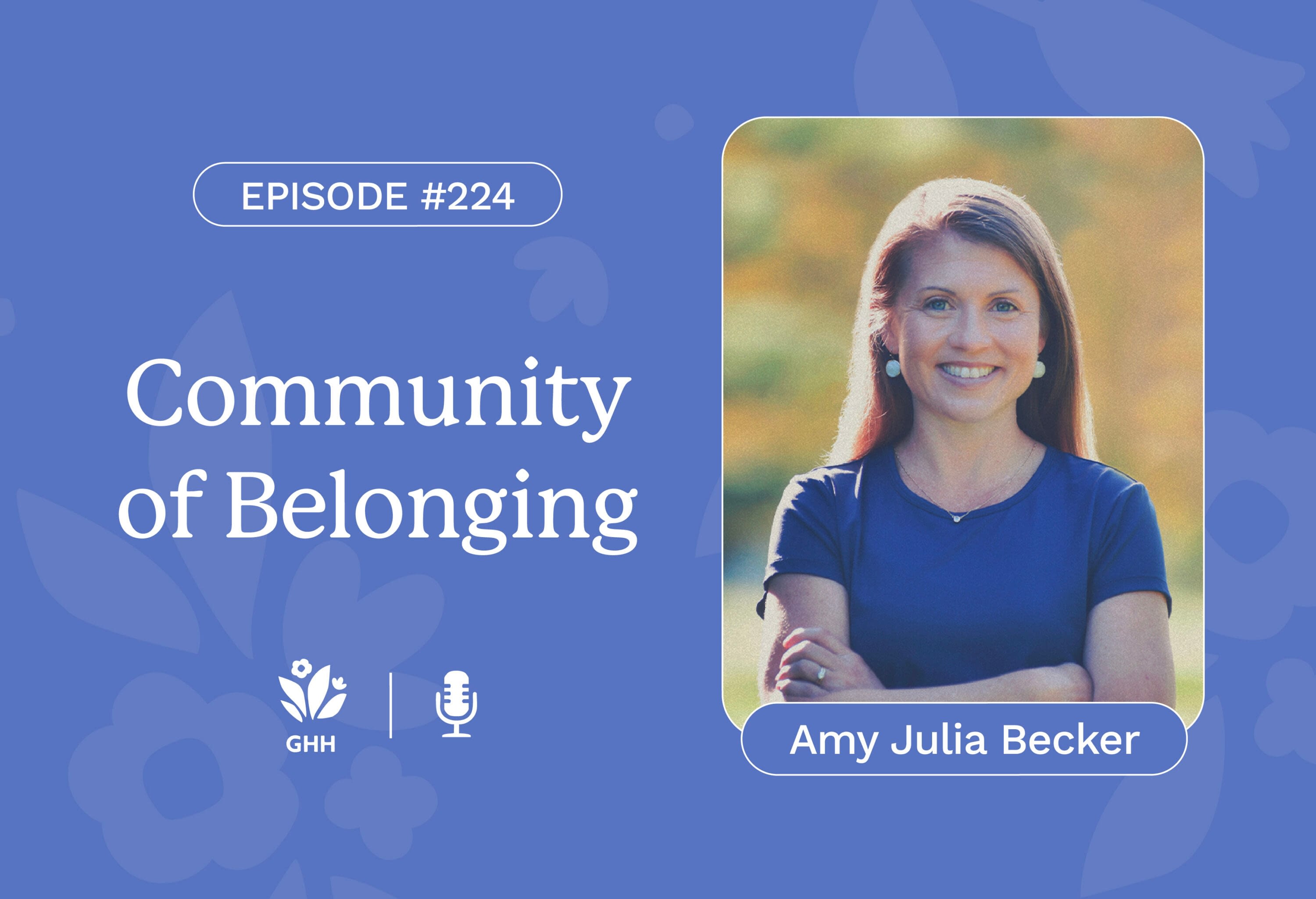
Community of Belonging
About this Episode
Episode Summary
When Amy Julia Becker gave birth to her first daughter, Penny, she was met with unexpected news—Penny had Down syndrome. In the midst of uncertainty, God began reshaping Amy Julia’s understanding of what it truly means to be made in His image and to belong in His family. Join hosts Eryn Eddy Adkins and Vivian Mabuni for a heartfelt God Hears Her conversation about motherhood, identity, and how God meets us in the moments we never saw coming.
Episode Transcript
God Hears Her Podcast
Episode 224 – Community of Belonging with Amy Julia Becker
Eryn Adkins & Vivian Mabuni with Amy Julia Becker
[Music]
Amy Julia: So, I think God looks at Penny and sees someone who is gifted, and who is limited and needy, and who is vulnerable, and I think He sees someone who has brokenness in various aspects of her body, and mind, and spirit. And I think He sees tremendous belovedness that goes even deeper than any of that. And I think all of that is true for me as well. And having that perspective on who she is has helped me to see others and myself so much more clearly.
[Music]
Elisa Morgan: You’re listening to God Hears Her, a podcast for women where we explore the stunning truth that God hears you. Join our community of encouraging one another and learning to lean on God through Scripture, story, and conversation at godhearsher.org. God hears her. Seek and she will find.
Vivian: Hey friends, before we get started, feel free to download or print our new Bible study show notes to fill out while you listen. You can find those on our website. It’s always wonderful to meet incredible women on the God Hears Her podcast, but when there’s a friend, it just adds a whole different layer of not only familiarity but just joy. So, I am thrilled to introduce to our listeners the wonderful, phenomenal Amy Julia Becker. She lives in Connecticut with her husband and her three kids. And just a little bit of background about Amy Julia, she is a grounded, humble, just a… a brilliant mind, but not in a stuffy kind of way. So, Amy Julia helps people reimagine the good life through her writing and her speaking. Her focus is on disability, faith, and culture, and she is the author of multiple books including To Be Made Well, White Picket Fences, Small Talk, and A Good and Perfect Gift. She’s also the creator of Reimagining Family Life with Disability, this workshop that she heads up, and she’s a guest-opinion writer for national publications, and she’s the host of Reimagining the Good Life podcast. And so, Amy Julia, I am thrilled that you are here. We want to just get to know you…
Eryn: Yay.
Vivian: … and have coffee with you over the miles. So, thank you for joining us on God Hears Her.
Eryn: Yes, welcome.
Amy Julia: Thank you for having me. I’m so glad to be here. And yeah, I’m really looking forward to this conversation.
Vivian: We are just going to dive right in. I would love to hear a little bit of your faith journey, like how you came to know the Lord, what was your faith journey like, and we’ll just kind of start at that point, and then we’ll move into the passions of your heart.
Amy Julia: Yeah. Well, I grew up in a church home where I enjoyed going to church, and I definitely, I think as a kid, had what I would call, like, an external relationship with God. It was kind of mediated through my parents and through the church and the idea of, like, being good and kind, and I… I liked all of that and I believed it all. At the same time, I would not say there was, like, an internal experience of God’s presence or an awareness of the Holy Spirit. I certainly had no motivation to be doing much of anything, prayer, Scripture, et cetera, on my own. You know, as I think many kids in that position feel that way. And then I actually went to boarding school when I was in ninth grade, so, pretty early on in my life. I was a young teenager and I remember being really challenged. There was no spiritual life at the school, and I didn’t have any friends who I knew had any sort of background of faith. I was learning things, as I think many kids in high school start to learn, that seemed to challenge my faith and my beliefs, and I have this very visceral memory of sitting at my desk and I had pulled out my Bible cause I thought it would be good to read my Bible. And I heard footsteps in the hallway and I was so scared that someone would come into my room and see me reading the Bible, that I threw it into the bottom drawer of my desk and slammed the drawer shut. And it sat there for the rest of the year. So that kind of gives a picture of who I was at, you know, age fourteen or whatever, earnest and well-meaning I think, and yet also very confused about what I believed, and also not at all convinced that I actually needed a relationship with Jesus. I thought it was good and nice, and possibly true, but not particularly relevant to me. But then my sophomore year in high school, the following year, I got really, really sick with what was a paralyzed stomach. So a very unusual situation for a fifteen-year-old to have a stomach that does not process food. I lost a ton of weight. I was…
Eryn: Gosh.
Amy Julia: … hospitalized off and on a lot that year, and it was really the first time that I thought, if God is real, then I need Him. And so, I need to actually earnestly ask this question. And I did that both through prayer and I read all sorts of books about the evidence for God and for the resurrection and those types of things. And then that summer I went to a young life camp. And I was there, I was still sick. I was… literally couldn’t eat solid food. I was just drinking like…
Eryn: Gosh.
Amy Julia: … old-person protein drinks…
Vivian: Wow.
Eryn: That’s so discouraging.
Amy Julia: … Like, it was terrible. I know it was really, really bad, but I also really knew that I did believe, and I wanted a relationship with God, and was praying about whether or not I should go back to the school that I had left to be hospitalized, and I felt, I mean, this has happened a couple times in my life, but a real clear, not my own voice but internal voice nevertheless, that said, go back to school and take Me with you… and I came back to this, like, young life gathering and people I didn’t know came up to me and said, what just happened, you are glowing. Like, there was just this real, I mean it really was this kind of marking moment for me. And from there, there was just this internal sense of knowing God’s presence and wanting to know more in terms of, again, reading the Bible, and praying, and telling other people about Jesus. So, I was very earnest again and zealous a little bit… for a couple of years there. And things have continued from there with plenty of ups and downs and lots of new understandings. But that is the beginning of what was really a faith journey that has lasted now for decades.
Eryn: I love that you used external and internal. How you shared your faith was more external, in your teens. And then what’s interesting and beautiful is that you experienced an internal pain and reached for the Lord in that… in that…
Amy Julia: Yeah.
Eryn: … in internal pain…
Amy Julia: Yup.
Eryn: … And then He spoke so audibly to you internally too, that it did shift your faith from external to internal, from physical pain to then also just meeting you and talking to you. I think that’s so beautiful.
Amy Julia: Thank you. You know, I think that God is very present in both the external and the internal. As much as we are invited into that, like…
Eryn: Yeah.
Amy Julia: … place of depth, and… and beauty, and assurance, right? Of, like, yes, this is a relationship that’s not just kind of out there, but actually, in here and for me.
Vivian: That’s so beautiful and isn’t it so amazing how all of our stories are different and the timing of everything. Just knowing you, Amy Julia, as a friend and understanding some of your story. I mean, you graduated from Princeton. You went to Princeton to get your MDiv, even, I mean, there’s… you’ve done graduate work. The boarding school you went to is extremely difficult, and challenging, and in the world’s eyes, I mean, it’s really something, you know, you could stack up your CV in a pretty profound way, and yet your heart is so much for the recognition of Imago Dei, the image of God in all people. And I would love to hear some of your journey and how God formed the heart that you have for a world of belonging.
Amy Julia: You know, it’s so interesting having started with that earlier question about the external and the internal because in some ways my answer to this question is similar in the sense that I think for me, when I was a student at Princeton as an undergrad and as a… in seminary and those kind of early years as a Christian, I definitely believed externally in, like, the Imago Dei, and wanting a place where people belonged… and wanting to participate in that. And yet I now look back and I think, but that was outside of me. And I didn’t actually know how as a, you know, upper middle class, educated, white woman, I got married young, I had a lot of stability in my life. I had a lot of opportunities that came to me as a result of, you know, education and all those types of things. I didn’t know how to do anything to kind of put into practice the idea of creating spaces of belonging. Not just welcoming others, but because I think what I had was a desire to welcome other people into my world and my culture to be like me…
Vivian: Yeah, yeah.
Amy Julia: … because I really did. I mean, again, I wouldn’t have said this at the time…
Vivian: Yeah.
Amy Julia: … but I did have kind of a hierarchy of humans and people who had what I had were at the top, and I wanted other people to be at the top, too. Like, it wasn’t like I wanted to stay there all alone or something, but I didn’t understand my own, honestly, my own place. And I didn’t understand the value of me actually moving out from the world that I had been in and encountering others and recognizing the tremendous value that they had, not by becoming like me, but in fact by welcoming me into their spaces. And that really began to shift when our daughter Penny was born. So…
Eryn: Okay.
Amy Julia: … I had… I was twenty-eight years old, and our first daughter was diagnosed with Down Syndrome a couple hours after she was born. And so, it wasn’t just that I had a child with a disability, but also an intellectual disability, which, you know, you’ve kind of spoken to the fact that, I mean, for my entire life I have just been someone who, like, loves the intellect, loves the mind, and I’ve always loved, like, books, and reading, and writing, and I think those are good things and God-given. But what that had meant by the time I was in my late twenties is that I was surrounded by other people who were just like me…
Eryn: Yeah.
Amy Julia: … And you start to just value those people when that’s what your whole world is…
Eryn: Yeah.
Amy Julia: … And so, being given a daughter with an intellectual disability was a tremendous shift in terms of me having to ask, okay, you say you believe in the Imago Dei, you say you believe that the image of God is not only in everyone, but that you actually can receive something of who Jesus is, only when you encounter others…
Eryn: Yeah.
Amy Julia: … and probably, especially when those others are different than you…
Eryn: Yeah.
Amy Julia: … But that was not the world I lived in or the life I led. And so that’s where again, I feel like that desire for belonging became much more internal and much more, like, robust in the sense of recognizing, wait a second, this is not about me knocking down walls so other people can come in and be like me. It’s about me, like, recognizing the mutual value of relationships that cross our social barriers.
Eryn: Yeah.
Vivian: Yeah.
Amy Julia: … Not that…. yeah, make everyone into some homogenous, we’re all the same type of thing. So yeah, that’s… I guess that’s where the journey of a desire for belonging started and then, you know, Penny is nineteen now. So, it’s been a long… a long road…
Eryn: Wow.
Amy Julia: … but a good one… for these past almost twenty years.
Eryn: Wow.
Vivian: Well, she is truly amazing, and it’s been a great. journey to see how that has brought about a real advocacy on your part…
Eryn: Yeah.
Vivian: … There’s also been a sense of just education. I remember reading your book, and language really matters, and I think you just very graciously expressed concern about using words like retarded, like, let’s not use words that are dehumanizing…
Eryn: Yeah.
Vivian: … And that shifted me as a mom, to help my kids know this is not a word that we’re going to be throwing around because it’s hurtful…
Eryn: Yeah.
Vivian: … but it really… it caused me to understand that the idea of proximity helps to change the framework of how we navigate life, and it… through my friendship with you, and through reading your book, it… it gave me a… an understanding and an insight that I did not have myself until having a friend who has a daughter with Down Syndrome, and learning the proper terminology and… and learning to lean in and to learn from. How do we continue to just recognize that all people inherently have dignity and value and worth. What’s some of the backstory that helped you to be able to kind of reframe the way you navigate life?
Eryn: Yeah, great question. Viv.
Amy Julia: Yeah, I could talk for too long about that. So, I’ll try to just give a few answers. I mean, really in the hospital, there was this moment where a nurse came in shortly after Penny was born. I was going to sleep. It had been about twenty-four hours of being awake and having, you know, had my first child, and gotten this news, and kind of spinning in so many ways. And the nurse said to me… I had a special child too, and I said, how old is your child now? And she said, he died a long time ago. So, it was like a really not what I wanted to hear. And I kind, I think I probably, you know, my eyes got big and I could feel my whole body at, like, not responding well. And I said, oh, I’m so sorry. And she shook her head, and it was very much a, like, no, no, you’re not understanding me. And she said, “He was a gift,” and she walked out of the room. And I never saw her again. And I… those words…
Eryn: Wow.
Amy Julia: … were, like, incredibly powerful, especially because I knew that I didn’t understand. Like, this woman who clearly lost her son when he was young, and therefore he was sick in some way, you know, I was like, how… how are you standing here telling me that he… he was a gift? I don’t… I… I think there’s something true here, but I don’t know what it means…
Vivian: Yeah.
Eryn: So honest.
Amy Julia: … Yeah, and soon after that, another friend of mine brought up, she was like, I was reading the Bible and I came to the passage where Jesus says, “Whoever receives one of these children in my name receives me.” And she said, I think that is a word for you that has to do with Penny, like, that if you can receive her, and she didn’t use the words as a gift, but obviously those things are related, right?
Vivian: Yeah.
Amy Julia: … if you can receive her, you’re receiving God’s work in your life, you’re receiving Jesus… and I don’t mean to make Penny out to be Jesus, but just that sense of Him really being in solidarity with, like, the least of these, the people who are on the low part of the totem pole, and American kind of status, hierarchy, the lowest rung of the ladder. And I didn’t know how to do that, but those were really early, very clear to me, like, I got to pay attention to this…
Vivian: Yeah.
Amy Julia: … and so, I began really looking for the gifts of the people who I would not typically see as those that I had something to learn from, to receive from, you know, I… I knew that I had gifts to offer in lots of situations. What was new to me was the idea that I had needs and that those needs would be often potentially met by the unexpected. The people who I, up until that time in my life, might have not even… literally, like, not even seen or acknowledged… not intentionally, but just because of the bubble I lived in…
Eryn: Yeah.
Amy Julia: … And so, I really started to look for, and… and trust that whenever I had an encounter with someone, there was something for me to give and something for me to receive. And I started to begin to really be able to… to see that. And then, you know, once you can see it, you believe it more and it kind of goes from there.
[Music]
Jade Gustman: Hey, friends. Do you need some encouragement right now to remind you how deeply God loves you? Check out our new 365-day devotional, God Loves Her, for a reminder of God’s love for every single one of your days. We also have a God Loves Her devotional journal if you want to go deeper. Check those out at the links in our show notes. Now, back to the show.
[Music]
Eryn: I would love to know the conversations your husband and you had. What… maybe the twenty-four hours from the hospital to, and you can share maybe, and then down the road and the journey.
Amy Julia: Yeah, so it’s really interesting. My husband’s mom died about two years before Penny was born, and our Penny is named after Peter’s mom. So…
Eryn: Oh, sweet.
Amy Julia: … her name was also Penny. So, we call her Grand Penny. There’s much, much, much I could say about that and the ways in which her sickness and death prepared us well to receive our Penny. But some of that was that we grieved really differently when his mom was sick, and also after she died. And at the time, in that time, we really judged each other for it. Where Peter thought that I did not have enough faith that she would be with God when she died, and that that’s why I was so sad. And I thought he was in total denial because he was leaning so much on the hope of seeing her again one day. And, you know, so, we really judged each other. And so, when our Penny was born, what Peter would say is that he went into the darkest twenty-four hours of his entire life. It felt like…
Eryn: Oh, wow.
Amy Julia: … he was at the bottom of the ocean where there was absolutely no light, and it… it was terrifying and awful. And then he came to the surface and essentially never went back there again…
Eryn: Wow.
Amy Julia: … And I would say that I never got to that depth of despair. And that it was about a year of really wrestling to… to be able to say I fully receive her as the gift that she is… and we were able to, like, let each other be in those places. I mean, I remember having a conversation with Peter…
Eryn: That’s beautiful.
Amy Julia: … pretty early on, where he said, he’s like, I do not expect you to be where I am. It makes perfect sense for you to feel the way you do, and I hope that me, you know, telling you that, like, I’m good does not make you feel like you’re supposed to be that way. So, he kind of recognized that in me and I remember saying to him, no, you’re giving me hope that I’m not going to feel this way forever. So again, we… we… somehow had shifted, and again, that earlier experience of grief I think really helped us with this into a place of both for him having compassion for me, and for me, kind of being able to, like, celebrate where he was…
Eryn: Yeah.
Amy Julia: … rather than comparing each other, and getting, like, judgmental and jealous. So, we had lots of conversations, certainly, about just fear for the future or…
Eryn: Yeah.
Amy Julia: … you know, what are other people going to think, and how are we going to handle all sorts of things. And, like, are we going to have… try to have other kids and…
Eryn: Yeah.
Amy Julia: … you know, we did not know what the implications would be for Penny’s health or long-term. I mean, you know, so we did have tons of conversations along the way, but I would say that those are the ones that stand out the most because there really was a sense of allowing each other to go through this, yeah, without judgment…
Eryn: Yeah.
Amy Julia: … and, and trusting that… that we could kind of hold each other up in that rather than…
Eryn: Yeah.
Amy Julia: … needing each other to do it exactly the same way.
Eryn: That’s so beautiful. Do you feel like the ability to grieve, and… cause that’s so honest, and I feel like you’d feel guilty grieving, you know…
Amy Julia: Oh yeah.
Eryn: … but to… to grieve maybe got you to the place to where you could receive her as a gift, versus…
Amy Julia: Yeah, yeah. I mean it… so, two things there. One, I… I would say that I realized eventually that I was grieving a hypothetical child. Like, there was… an expectation in my mind of who Penny was going to be, and she was not that person…
Eryn: Wow, yeah.
Amy Julia: … And I grieved that person as though she had been a real person who we lost, but we hadn’t actually…
Vivian: Right.
Amy Julia: … So, there’s… the experience felt a lot like grieving a baby who had died. But eventually I realized that actually that baby never existed and you’ve been given this one. And that was like a tremendous gift to recognize that, but I also felt like what the grief did was it… Basically, I feel like there are some times where there’s, like, holy grief, there’s a beauty to the grief because it is recognizing the things that are not right with this world. So, when my mother-in-law died of liver cancer, it’s, like, there’s a holy grief in saying, like, I wish my kids knew their grandmother. You know, like, that…
Eryn: Yeah.
Amy Julia: … I think that’s a good thing. But then there’s also ugly grief, which is what a lot of my grief when Penny was born was about, which really was surfacing in me the ways that I valued people in a hierarchical way…
Vivian: Wow.
Amy Julia: … The fact that I thought that people with intellectual disabilities were more broken than people like me… the fact that I had effectively cut myself off from people like Penny for my entire life, and was basically, like, I don’t want to know those people. You know…?
Eryn: Yeah, yeah.
Amy Julia: … I mean, and at that point they were those people as opposed to…
Eryn: Yup.
Amy Julia: … like, my daughter, who I… of course I now am like, I can’t believe I have the honor and privilege of being your mom and of knowing your friends and of being in this whole world. So, I think the grief is really important. You’re absolutely right that there’s a lot of guilt in the grief…
Eryn: Yeah.
Amy Julia: … But I do also feel like it’s important to acknowledge that that’s for many people who have not already had the experience of recognizing the gift that… that all people are, you know, including those…
Eryn: Yeah.
Amy Julia: … with intellectual disabilities. It’s very normal to go through a period of grief and also, there’s, like, so much hope for that grief. And… and not all people experienced this the way I did, but that… I do not experience grief over Penny’s existence, over her life, at all. And that’s… really was that sense of, like, grief that was turned into joy… and we’re… we’re really grateful for that.
Vivian: I would love for you to kind of pull back because you even the title of your first book, A Good and Perfect Gift… how do you think God sees Penny? How does that impact and change our, even our hearts? You’ve kind of alluded to some of that, but I would… I’m curious with how you would answer that question.
Amy Julia: Yeah. So, that word perfect is maybe the place to start in trying to answer that question. I grew up, I’m the oldest of four girls and I have, you know, two married parents, again, kind of upper middle class, educated, blah, blah, blah. And… we were all blonde, so you have like these four little blonde girls running around and we were called the perfect family for a lot of my upbringing. And that was just a name, a word that was kind of given to us often. And so then, starting my own family, having our own daughter, and I wasn’t thinking about the word perfect at all until, before the nurse said that thing about the gift…
Eryn: Yeah, yeah.
Amy Julia: … but after Penny was born and diagnosed, there was a woman giving birth in the room next to me in the hospital. And after she gave birth to a baby girl, someone in the room with her just started, like, shouting really loud, She’s perfect, she’s perfect, she’s perfect. and it truly felt like this contrast. As it happened, that woman also was, like, in my same class at seminary, like, we were classmates, so…
Eryn: Yeah, okay.
Amy Julia: … it was like, we are, and her name was Amy. It’s like, we’re, like, the same person having babies at the same time…
Eryn: That’s wild.
Amy Julia: … hers is perfect and mine is not. Like, that’s really what it felt like. And I was really stuck on the verse from Matthew 5 where Jesus says, “Be perfect, as your heavenly Father is perfect.” But I was in seminary at the time, so I was able to look up the Greek, which is harder for me now than it was then… but I looked it up, and the word that’s translated as perfect has a root, telos. And telos means, like, the end for which you are created… the purpose for which you’ve been made. And so, that was really different. I… yeah, I looked up perfect in, like, the English dictionary and it said, “conforming absolutely to an ideal type.” So, we think about, like, having the perfect body or having…
Eryn: Wow.
Amy Julia: … even, like, that idea of, like, the perfect family. Usually I think in America, when we talk about perfection, that’s what we’re talking about, like…
Vivian: Right.
Amy Julia: … conforming absolutely to the ideal type…
Vivian: Sure.
Amy Julia: … and Penny did not conform absolutely to the ideal type. That was true…
Vivian: Yeah. Yeah.
Amy Julia: … and it’s so different to say, “Be who you are created to be, as your heavenly Father is who He is.” Right? Like, that was like this tremendous freedom…
Eryn: So beautiful.
Amy Julia: … and invitation, not just for me to see Penny as perfect as one who is invited to be who she is created to be, but also to see myself that way. That was, like…
Vivian: Yeah.
Amy Julia: … tremendously shaping and forming for not just my view of her but of me, which gets back to how do I think God sees her. And I do think that again, God is able to see the… His image in each of us. And that sense of growing in faith is honestly conforming less and less to an ideal type, and more and more, and this is what’s so beautiful about being in the image of God, that idea that, like, it’s not one type. It’s actually this incredible breadth of gifts, and talents, and opportunities, and humans, right? I mean, it… whether that’s how we look, or what we’re good at, or our personalities, or our…
Eryn: Yeah.
Amy Julia: … gifts and offerings in the world, or our needs…
Eryn: Yeah.
Amy Julia: … So, I think God looks at Penny and sees someone who is gifted, and who is limited and needy, and who is vulnerable. And I think He sees someone who has brokenness in various aspects of her body, and mind, and spirit, and I think He sees tremendous belovedness that goes even deeper than any of that. And I think all of that is true for me as well. And having that perspective on who she is has helped me to see others and myself so much more clearly.
Vivian: Wow. I just got goosebumps. Thank you, AJ, that was really, really powerful. When you think about those moments in the hospital, and now, Penny’s nineteen years old, I mean, and she’s been a cheerleader. She’s gone to prom, and dances, and concerts, and I mean, she’s lived such an incredibly beautiful life with a family that loves her and that she loves back… It’s just been so powerful to watch as a friend traveling along, but what kind of advice would you give to a mom who’s just been given the same news about a son or daughter?
Amy Julia: Yeah, I mean, there’s lots to say, but…
Eryn: Yeah.
Amy Julia: … you all mentioned I’ve been kind of teaching this workshop called Reimagining Family Life with Disability, and there are really three things that I talk about in that workshop, which I think is probably what I would say in some form to that mom. And the first is to take delight in your child. And that doesn’t mean that there’s no place for the lament or the grief, I hope I’ve already really…
Vivian: Yeah.
Amy Julia: … acknowledged and honored that… the need I think that many of us at least have to go through that, and there’s a whole conversation we could have about suffering as it relates to disability. And I’m by no means trying to be like, no, just be positive…
Eryn: Yeah.
Amy Julia: … At the same time, the world tells us, and this is true even in the disability world, it’s true even in the church world…
Vivian: Right, right.
Amy Julia: … but to see people with disabilities as… in terms of their deficits, weaknesses, and brokenness instead of in terms of their giftedness, belovedness, and the reasons to delight…
Vivian: Wow.
Amy Julia: … And those things are really, really present. Like, again…
Eryn: Yeah, yeah.
Amy Julia: … image of God. There we go. So, like… take delight in the love you have for your child. Take delight in the smile or the warm hand or, I mean, again, we’re talking about babies here, like, just take delight in the fact that you get to… whether… you know, many moms in this position might have a baby in the NICU, so you might not be able to hold that…
Eryn: Right.
Amy Julia: … little baby in your arms, but if you get to hold their little toe, I mean, how much delight…
Vivian: Yes.
Amy Julia: … can you have in that? So, like, take delight in the gift of this child. And then secondly, connect to community. You need other people. I actually have, like, nine different sets of people to think about. But I would start with peers and mentors. So, other people who are in a similar situation to you are, kind of what we think about as, like, a support group. But then mentors, people who have traveled this road before you and can…
Vivian: That’s good.
Amy Julia: … listen, can give some practical advice, but can also tell you that you’re going to be okay. And then finally, after the take delight, and connect to community, the last thing is just take one step towards a good future. So, I think one of the things that I know for me, when Penny was born, I felt like I had no way to envision a good future…
Vivian: Right.
Amy Julia: … My imagination had been shaped by typically developing kids, not by kids with Down Syndrome. And so, I didn’t know that it could be good. So, that was part of kind of the taking delight and connecting to community was beginning to see, oh, wait a second. Maybe this could be good. And then to be like, yeah, take one step in that direction. You don’t have to take seventy-two. You don’t have to do all the things that all the experts are going to tell you. But you can take one step to go in that direction. So, those are kind of my…
Eryn: Those are good.
Amy Julia: … like, go-to answers on this point. But they really have, I mean, even now, Penny’s nineteen. We thought she had a summer job. We just found out she didn’t. I was very inclined to panic and to go, ten years from now, she’s not going to… still not going to have a job. And you know, all the things that we do as parents, where we catastrophize our children’s futures, right?
Eryn: And spiral.
Amy Julia: Yeah. And I was like, okay, take delight, connect to community, take the next step towards a good future. And it was literally, like, okay, the next step is just to talk to my husband and brainstorm. And then the step after that is to say, Penny, who are you going to reach out to… to try to see if there’s another opportunity.
Eryn: I would love to know, so, you shared a little bit about what that experience was like in processing the news with your husband. Now, what does life look like in parenting? Could you speak a little bit into what parenting is like now for you guys, and how you guys work together as a couple in unity?
Amy Julia: Yeah, so oftentimes you’ll hear a statistic that eighty percent of parents of children with disabilities divorce…
Vivian: Wow.
Amy Julia: … And I just was like, I’m not sure that’s true. I have a lot of friends who are parents of kids with disabilities, and some have gotten divorced, that’s true…
Vivian: Yeah.
Amy Julia: … And others have not, and a lot of others have not. And I just wrote a post about how that’s actually not true. I mean, it came, it’s like you read a Psychology Today thing that’s quoting from a study that was only about a certain subset of parents about who… and… and then you can’t even get to the main source. And there’s another study that the National Institutes of Health conducted in 2015 that says parents of children with Down Syndrome are actually more likely to stay married…
Vivian: Wow.
Amy Julia: … There are certain times in the life of children with Down Syndrome, it’s actually very young, and for children with autism, it’s the teenage years. Those are the most fragile times for marriages. So, again, there are reasons for parents of children with disabilities to be like, woo, we might need extra support during those times. And for friends and family to know that that’s true…
Vivian: That’s good.
Amy Julia: … But it’s… there’s not a difference in the divorce rate for parents of children with disabilities and the rest of the population speaking in broad terms. And that should, I think, be really important for us to know…
Eryn: Yeah.
Vivian: Yeah.
Amy Julia: … There are fragile moments and moments when we can gather around and really be, I mean, we always can be supporting each other, but especially in those times. So, that’s the first thing…
Eryn: Yeah.
Amy Julia: … The second thing I’ll say is that one of the words people used was abnormal, and it felt abnormal. And now, like, disability is really normal in our family…
Vivian: Yeah.
Amy Julia: … Like, it’s our daughter. I mean, it’s… it’s a part of who we are as a family, so parenting Penny is different than being a parent to our other kids, but it’s different in… Peter said early on, having a child with a disability, it was like a magnifying glass. Like, it just was kind of clearer and bigger…
Vivian: Wow.
Amy Julia: … And that is still true. I mentioned that Penny needs a summer job, and that’s true for all of our kids, but we feel like we are more hyper-focused in helping Penny with that than we might be with our other children because of some of the needs that she has. I’m the primary caregiver in our household. I work in a much more flexible job than him. So, there are times where I’m like, hey, I need you to step up now. I… and that might be I’m just feeling alone and overwhelmed. It might not even be about time. Sometimes it’s about time. Sometimes it’s just…
Eryn: Yeah.
Amy Julia: … about I feel alone and I need you to step up. So, a lot of that goes back to just being honest with each other in what we need. As far as what it looks like to parent… be a parent to Penny, we are figuring that out as she becomes an adult. In terms of, there’s a phrase that again, I think is applicable to all parents, but it’s used in disability circles called the dignity of risk. So, what are, like, the proper risks for us to allow her to take…? Because it’s easy for parents to become kind of helicopter parents of any kids…
Eryn: Yeah.
Amy Julia: … That’s especially easy when you know your kid is more vulnerable. And yet she deserves that dignity to be able to take risks and to sometimes, like, mess up, and fail…
Vivian: Yeah.
Eryn: Yeah.
Amy Julia: … and get hurt. And again, we need to be careful that we’re not putting her in, like, incredibly dangerous situations, but also letting her…
Eryn: Yeah.
Amy Julia: … take steps forward. So, we just, I mean, honestly, we talk a lot… we lean on each other a lot. We say when we’re feeling alone, and we try to let go increasingly as Penny steps into her own life as an adult… a young adult with Down Syndrome.
Eryn: Love that.
Vivian: Yeah. That is helpful and… and applicable to all of us…
Amy Julia: Right.
Vivian: … It just in… so… so thank you, but… especially for a mom, just to hear words of hope like that, and practical advice…
Eryn: Yeah.
Vivian: … I really, really appreciate. It’s clearly been thoughtful and lived out, so…
Eryn: Yeah.
Vivian: … thank you for… for doing that.
Eryn: Amy Julia, will you pray? Maybe pray for the woman where family doesn’t look like what they thought it would look like, and how God can come into those places and help us reimagine future. Would you do a prayer for that?
Amy Julia: Yeah, absolutely. Lord, we bring to you all of the places in our hearts and souls that feel uncertain and that we want to cry out, I don’t think it’s supposed to be this way. And we pray for You to help us sort through where there’s truth in those statements, that You would comfort us in those places where there is suffering, where there is loss, where there is holy grief. And we also pray that You would transform grief into joy. That You would help us to not only be honest and express our needs, but also hold on to hope for the goodness that You have both on this side and on the other side of this life. I pray that You would give us people… to come alongside us to speak words of comfort and assurance without dismissing our lament and our need. And I pray that You would bring people alongside us to help us take those one step forward towards the good future that You envision for us. You are a God of comfort. You are a God of peace. You’re a God of love and of joy. Even when it does not seem possible for those things to be true, that we would hold on even to the smallest mustard seed of faith knowing that You can do great things through those small, small, little seeds of faith. So, I pray God, for any women who are listening to this today and who need You to be with them, and comfort them, and who need other people for You to provide to be with them and to comfort them, that You would give them just a glimmer of the good future that You have in store for her and for her family. And we pray all these things in Jesus’ name. Amen.
Eryn: Amen.
Vivian: Thank you, Amy Julia.
Amy Julia: Thank you.
[Music]
Eryn: Well, friends, be sure to check out our website to subscribe to our email list, read the newest blog article, or check out the God Hears Her books and devotionals. Find that and more at godhearsher.org. That’s godhearsher.org.
Vivian: Thank you for joining us. And don’t forget God hears you, He sees you, and He loves you because you are His.
[Music]
Eryn: Today’s episode was engineered by Anne Stevens and produced by Jade Gustman and Mary Jo Clark.
Jade: We also want to thank Judy and Megan for all of their help and support. Thanks, everyone.
Vivian: Our Daily Bread Ministries is a donor-supported nonprofit ministry dedicated to making the life-changing wisdom and stories of the Bible come alive for all people around the world.
[Music]
Vivian: God Hears Her is a production of Our Daily Bread Ministries.
Show Notes
- “This is not about me knocking down walls so that other people can come in and be like me. It’s about me recognizing the mutual value of relationships across our social barriers.” —Amy Julia Becker
- “What was new to me was the idea that I had needs and that those needs would often be met by the unexpected—the people who, up until that time in my life, I would not have even seen or acknowledged because of the bubble I lived in.” —Amy Julia Becker
- “The world tells us to see people with disabilities in terms of their deficits, weaknesses, and brokenness instead of in the terms of their giftedness, belovedness, and the reasons to delight. And those things are really present!” —Amy Julia Becker
Links Mentioned
- God Loves Her Devotional: https://www.amazon.com/dp/1640704213?ref=emc_s_m_5_i_atc
- God Loves Her Devotional Journal: https://www.amazon.com/God-Loves-40-Day-Devotional-Journal/dp/1640704515
- Watch the episode on the God Hears Her YouTube channel
- Share Your Story
- God Hears Her email sign-up
- Subscribe on iTunes!
- Elisa’s Instagram: elisamorganauthor
- Eryn’s Instagram: eryneddy
- Vivians Instagram: vivmabuni
- Our Daily Bread Ministries Website
Bible Verses:
Related Episodes:
- GHH Ep 3 – When I’m in Pain with Xochitl Dixon: https://godhearsher.org/podcast/when-im-in-pain/
- GHH Ep 117 – Meeting Special Needs with Elrena Evans: https://godhearsher.org/podcast/meeting-special-needs/
About the Guest(s)
Amy Julia Becker
Amy Julia Becker helps people reimagine the good life through her writing and speaking on disability, faith, and culture. She is the author of To Be Made Well, White Picket Fences, Small Talk, and A Good and Perfect Gift and the creator of the Reimagining Family Life with Disability workshop. She is a guest opinion writer for national publications and hosts the Reimagining the Good Life podcast. Becker is a graduate of Princeton University and Princeton Theological Seminary (MDiv). She lives with her husband and their three children in western Connecticut.
Comments

More Episodes
Get Connected
Sign up to get early access to new book releases, podcasts, blog updates, and more!