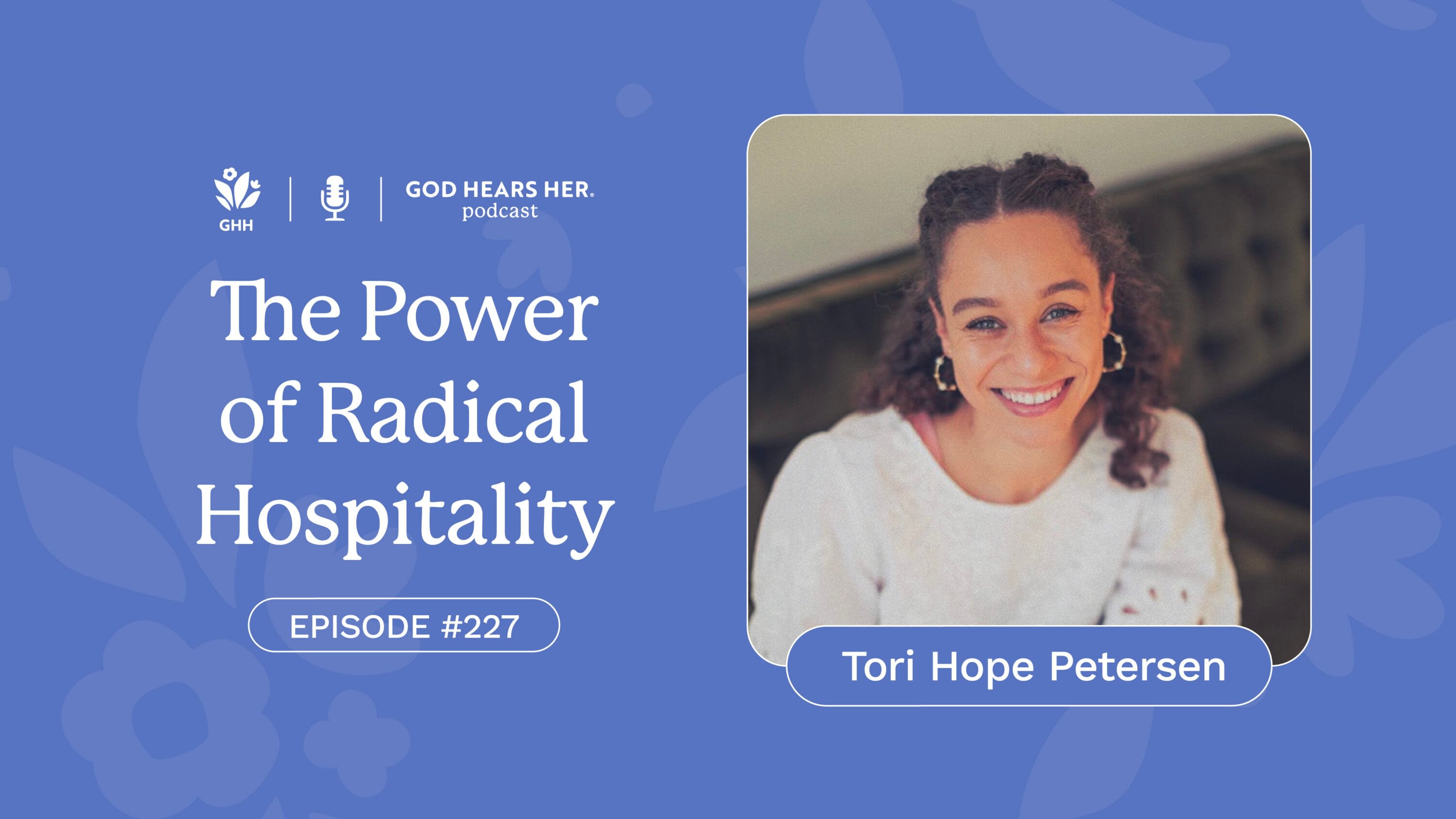
The Power of Radical Hospitality
About this Episode
Episode Summary
God desires for each and every one of us to feel loved and valued, but throughout our lives we face moments where we may feel unlovable or worthless. Tori Hope Petersen struggled with these feelings deeply as she grew up in multiple foster homes. When one of her foster moms honestly answered one of Tori’s questions about God, it completely changed her life. Now, Tori shares her story to inspire people toward radical hospitality and an ever–present, loving Father. Join hosts Eryn Eddy Adkins and Vivian Mabuni as they learn about Tori’s time on Season 2 of Unshakable Moxie and more of her personal testimony during this episode of God Hears Her.
Episode Transcript
God Hears Her Podcast
Episode 227 The Power of Radical Hospitality with Tori Hope Petersen
Eryn Eddy Adkins, Vivian Mabuni, Tori Hope Petersen
[Music]
Elisa: You’re listening to God Hears Her, a podcast for women where we explore the stunning truth that God hears you. Join our community of encouraging one another and learning to lean on God through Scripture, story, and conversation at godhearsher.org. God Hears Her, seek and she will find.
Vivian: Eryn, we are in for a treat today. Sitting with us here…
Eryn: We were just holding hands before.
Vivian: I know, we were just holding hands.
Tori: We’re just gonna hold hands the whole time.
Vivian: This is…I know, seriously. So Tori Hope Petersen is here in the studio. She is a dear sister to me, and we’ve known each other for a few years now. But Tori is the real deal. And, um, you know, we could list all the things, you know, you know, a bestselling author and a sought-after speaker and a fierce advocate. I…she will never say this because she’s a humble woman. But Outreach Magazine, uh, she is one of the 20 rising leaders for this generation and the next. I mean she was named as that. So I did not know that until I read your bio, Tori. But what I love about Tori is she is the combination of kind and fierce. And, um, I love, Tori, w…your heart for people. You are a lover of people. You are compassionate, and you have a heart for hospitality. And you just keep opening your life and your home. And I feel a little emotional, but I really genuinely mean that. And so it is such a treat and an honor to have you. So…
Tori: Thank you.
Vivian: … thanks for being on the God Hears Her podcast.
Eryn: Yes, welcome.
Tori: Thank you, Viv. It’s an honor to be here. Early on in my faith, I read a book by Brennan Manning, and in it he said that our mission as Christians is to be a professional lover of people.
Eryn: Mm.
Tori: So the fact that you said you’re a lover of people, I’m like, that is exactly … that has…that phrase has impacted my faith greatly. So when you said that, I was like, Oh, that is exactly what I want to be known for. Thank you.
Vivian: Yes, yes.
Eryn: So t…how do…how do y’all know each other?
Vivian: We, uh, Tori is in the very first, graduating this May of 2026.
Tori: Okay, I feel like this is Viv being humble now. So let’s go.
[crosstalk]
Eryn: Come on, Tori. Come on, let’s go.
Tori: Okay. Viv is the founder of the Women’s Leadership Cohort at Denver Seminary, and we call her Queen Viv…
Eryn: Oh.
Tori: …because she was the one that started it for all of us. And so it’s really special, because she created this safe space for women who are platformed in ministry in some way or platformed, um, in their work. And she created this safe space for all of us to learn about God alongside one another in really deep ways. And it’s…we’re learning, you know. The beginning of it was so much based off learning about like Scripture in its context, history. But as time has went on, it’s become more like spiritual formation, and it’s a place, because of how you’ve created it. It’s begun to be a space where you can be vulnerable um, with one another. And it’s just been really unique and such a blessing. And so that’s how we know each other, because Viv is a trailblazer.
[laughter]
Vivian: Well, Tori, you have been part of Our Daily Bread through being a part of the Moxie…
Eryn: Mm-hmm.
Vivian: … documentary with our dear, mutual dear friend, Toni Collier and Mariah. And, um, so they…the whole team, has come to your home to be a part of this incredible, um, narration and story and different emphases. And I think what’s so beautiful about, you know, them coming to your home was the fact that you could host them.
Tori: Mm-hmm.
Vivian: And I was curious, you know, Eryn and I, we would love to know, like, why you said yes to being a part of Moxie.
Tori: Well, Toni Collier asked me, so that was at first an indication of, like, I think this would be something that I would care about. Because Toni, I think, is a woman of great integrity, and I love her dearly. And secondly, as we started to talk about the storyline, a lot of people…and I…I feel called to tell my story in this way, but a lot of ministries only want to hear my story from the perspective of enduring abuse and trauma, my childhood, and the healing that I have found through that. And I feel that that is part of my calling, to share that. But also because of my upbringing, one of the things that has, you know, formed who I am and that has stamped our family, the vision of our family, the mission and ministry of our family, is radical hospitality, welcoming people into our home day in and day out, loving our neighbor, loving the stranger. And Unshakeable Moxie wanted to tell and shine a light on my story from that point of view and from that perspective. And for me, I felt like that was dignifying…
Eryn: Yeah, yeah.
Tori: Um, it was honoring to me.
Eryn: Mm-hmm.
Tori: And it made me, like, you know, people…I think when they see me, they think my gift is teaching and preaching. They think my gift is writing and communicating. That’s actually not my gift. My…my gift, if I was to own it…
Vivian: Mm-hmm.
Tori: …is hospitality. It is welcoming people in. This speaking and writing does not come so naturally to me, but I know it’s a part of the work that God has called me to do, so I walk in it faithfully. But what I feel the joy of doing and what I feel God has called me to do above everything else is welcome people into my home and minister to people in that way. And so when they wanted to shine a light on that part of my ministry, um, I think it…it just felt dignifying. And I was like, “Yeah, I want to…I want to do this.”
Vivian: That’s so great. Well, for our listeners who don’t know your story, would you share with us some of your story? Tell us your…your spiritual journey, your…
Eryn: Yeah, where did it begin?
Tori: Yes. Oh my goodness. Where did it begin? Well, the story that people tend to know about me is that when I was four years old, I went into the foster care system for the first time, and then I was reunited with my biological mom. And people, you know, we say that that’s one of the roles of the foster care system is to reunify families. And I like to say that one of the roles of…the main role of the foster care system is to make families whole, and that can be done in a lot of ways.
Eryn: That’s good.
Tori: But at that time, I was reunified with my biological mom, which I was very happy because I…my mom always communicated that she loved me. She wanted to care for me, and I think she did the best with what she had. My mom grew up and experienced a lot of trauma in her childhood. And so I think some of those, unfortunately, some of those generational cycles were passed on. And so as I got older, the dysfunction in our home became significantly worse, and so I had to reenter the foster care system when I was an adolescent. I was 12 years old. And then throughout that time, I moved throughout 12 different homes. And that was a time where I felt very unloved, very unwanted. And then when I was 18, I did what is referred to as emancipation or aging out of the foster care system. So the day I turned 18, like 20 percent of youth who grow up in foster care, I was instantly homeless. I did not have anywhere to go. And that, at that time, you know, when that’s happening, I just felt so displaced. And those words unwanted, unloved really were what was a part of my identity. Like, that’s who I thought I was. The only thing that I…
Eryn: Yeah.
Tori: …wanted was a family. I did have Christian foster parents, and so I was in the church at times. And I heard about the character of Jesus, and I was quite drawn to Him. Like, I was like He sounds very kind. He sounds very loving. He sounds like a dude I could get down with.
Vivian: Sure.
Tori: And I was interested in who God was, But I had a lot of questions for God cause I didn’t understand if…if God is so good, then why do kids suffer? You know, innocent kids.
Eryn: That’s a great question.
Tori: Why are they abused by…by their parents? And why didn’t I ever have a dad that would have…I thought that would have solved so many of my problems. You know, my mom…
Eryn: Yeah.
Tori: … was a single mom who was truly doing the best that she could. And I thought if I would’ve had a dad, maybe I would’ve had someone to protect me from the abuse, or I…I would’ve never went into the foster care system in the first place cause I could’ve lived with my dad. So I had a lot of bitterness and anger within me because of those questions. But I had a foster mom…this was my 12th foster home. This was before I aged out. I had a foster mom who was taking me to church pretty consistently, pretty regularly, and I asked her those questions.
Vivian: Yeah.
Tori: And she looked at me. We were sitting…I’ll never forget it. We were sitting on her bed. I was at the end of her bed, and she had her Bible open. And she just looked at me, and she said, “I don’t know. But I think that we can figure that out together.”
Eryn: Oh.
Tori: And it was the first time that I’d ever heard a Christian say, “I don’t know”, and it felt like I wasn’t the only one who didn’t have all the answers for the first time. Like…
Vivian: Wow.
Tori: … someone else also doesn’t have the answers. But she still loves God. And so that moment, I think I became more open…
Vivian: Sure.
Tori: … to want to learn about God. I think I that was probably the moment that I started paying attention in church…
Eryn: Yeah.
Tori: …a little more. And what I was learning in church was that Christ suffered. And I’m not saying that God allows our suffering…
Eryn: Right.
Tori: …but what I saw in Christ’s suffering is that it wasn’t wasted. And that gave me so much hope for my own suffering, that my suffering maybe could be used for some kind of good in God’s glory. And so that was my answer to that question, but then I still had the question, why didn’t God give me a dad?
Vivian: Yeah.
Eryn: Yeah.
Tori: And my church was doing worship one Sunday morning, and maybe they’d done this song before. I don’t know. But it was the first time that I’d really heard it. They were singing the song “Good, Good Father.”
Eryn: Hmm. Mm-hmm.
Tori: And I started to sing the lyrics, and I didn’t… again, I didn’t… wasn’t like I’m in this whole God, Jesus thing.
Eryn: Yeah.
Tori: I was open. And we started singing the song “Good, Good Father,” and that was the moment it just clicked for me. I was like, “Oh, God is my Father.”
Eryn: Mm.
Vivian: Wow.
Tori: God has always been my Father. He’s been preparing me, loving me, protecting me throughout this entire journey. And God as my Father, as my heavenly Father, has filled every gap that an earthly father could have never filled. And so that was the moment that I accepted Christ into my life.
Eryn: Wow.
Tori: And those labels of like, unwanted and unloved really began to be transformed, and I wouldn’t say they were totally transformed. They were things that I still had to work throughout my healing journey, and still am a little bit. But I would say that was the moment I realized even if these people, these families don’t want to call me daughter, God does. And even if I’m kicked out of home after home after home, God has created a room for me in the kingdom of heaven, and that trumps any home that I could be welcomed into on Earth.
Eryn: Tori, I’m so moved by just your honesty and those questions that you were having, like, “Why?” like, “Why not me?” Like, “Why can’t I have a dad?” And then just being so honest with God and going like, “I want to know where You were, like, when I was not being protected?” Would you say that in that journey of discovering who God is, what He is in your life, did you have any anger, or was it sadness mainly? Like, cause I’m so moved by your openness, so it’s like for that openness, there had to have been something before it. Was it anger, sadness? What…
Tori: Yeah, I felt like it was sadness.
Eryn: Yeah.
Tori: But the adults in my life…
Eryn: Yeah.
Tori: You know, I think when you’re that young, you are…I was not as self-reflective…
Eryn: Yeah.
Tori: …as I could be now, and I didn’t have a self-awareness.
Eryn: Yeah.
Tori: Um, I especially think having all that trauma probably made me even less self-aware than your average 17 or 18-year-old.
Eryn: Sure.
Tori: But the adults in my life told me that I carried a lot of anger. And when I look back on that time, I would probably say that that was an accurate observation.
Eryn: Yeah.
Tori: Um, I think there was a lot of unforgiveness in my life. Um, there was a lot of blame in my life. Um, and I think when we carry those things, you know, they… it was…it was such a burden.
Eryn: Mm-hmm.
Tori: It was so heavy, and then it translated into an anger and a bitterness.
Eryn: Yeah. What… was there a moment that you realized that to break free from it? Or do you think it’s ever- ever-evolving…
Tori: It…
Eryn: …of breaking off?
Tori: …was definitely an…it was definitely an ever-evolving thing. So I would say one of the most, you know, prominent moments that I remember in understanding that I needed to forgive, I was actually not yet a Christian.
Eryn: Mm-hmm.
Tori: I was probably 15 years old, and I was living in a group home. So for people who don’t have context for what a group home is, it is more so of an institution that kids in foster care go to because maybe caseworkers can’t find a home for them, or they need behavioral treatment or something like that. So I was in a group home at this time, living with nine other young women. And during the summers, we did group therapy. And so during that time in that group therapy, we were all required to tell our story. And there was a young woman who was named Jen. We’ll say that her name was Jen.
Eryn: Yeah.
Tori: And Jen was like the youngest in our home. And so we all found that she was the most annoying. We all found Jen to be…
Vivian: The kid sister.
Tori: Yeah, she was a little sister.
[crosstalk]
Eryn: Yeah.
Tori: We all found her to be annoying, immature. And it was Jen’s turn to tell her story. And I would say that Jen also had probably the biggest behaviors of all of the girls that lived in, you know, we’re all living in this home together, we’re all carrying trauma. We’re all having these like implosions every day.
Eryn: Sure.
Tori: And Jen probably required the most attention of the staff, things like that. It was Jen’s turn to tell her story, and she started to talk about how she was trafficked by her parents. She was abused throughout her childhood. They had to rupture her adoption, and then she had to be adopted by another family. And as she was telling her story and as she was talking about the trauma that she had endured, I realized that there were pieces of her story that reflected my mom’s.
Eryn: Hm. Oh, wow.
Tori: And I was looking at this little girl named Jen, and it was like I saw my mom…
Eryn: Aw.
Tori: …as a child.
Vivian: Yeah.
Tori: And I think that was the moment that I was like, my mom, I knew in my heart that my mom wasn’t given what she was supposed to be given from her parents, from the people who were supposed to love and protect her. And at, you know, 15 years old, I forgave my mom. Because I saw her not as a mom, not as a grown-up who was supposed to provide for me but as a child who wasn’t provided for.
Vivian: Wow, that is incredible. Thank you for sharing that. Yeah. Forgiveness, has that been a point in time or an ongoing kind of forgiveness? What has that been like for you?
Tori: I think it’s definitely been ongoing. I’ve had to forgive my abusers, the people who have hurt me over and over and over again. Because the trauma comes back in waves.
Vivian: Yeah.
Tori: And the healing hasn’t been linear at all. It’s been like a rollercoaster.
Vivian: Yeah, yeah.
Tori: And so when those triggers come back or when the trauma starts to rear its head again, I think that’s when the [angerness] and the bitterness comes back.
Vivian: Mm-hmm.
Tori: Because it’s like, “Why did I have to be abused in this way by this person, and then it results in this trigger? And if that wouldn’t have happened, then this wouldn’t be what I’m living in right now.”
Vivian: Sure, sure.
Tori: And, you know, throughout my adult life, I’ve had ruptured relationships. I have had so much brokenness, and mu…much of that I know has been a product of not learning how to have good relationships, not learning how to regulate myself at a young age in the ways that parents typically teach their children to do.
Vivian: Right.
Eryn: Yeah.
Tori: And so I feel like I have had to…part of forgiveness has been taking my own responsibility. Like, the stuff that happened to me, the pain that happened to me as a child wasn’t my fault. But the way that I heal and what I do with it as an adult is my responsibility.
Eryn: Yeah.
Tori: And I have had to not continue to look back and continue to cast blame, because I’m an adult…
Eryn: Yeah.
Tori: …and it’s my responsibility now. And so part of doing that, part…part of not casting blame and taking responsibility today has been forgiving over and over again. And I think oftentimes when we’re like, “Oh, I’m not gonna forgive that person, I’m upset with that person,” we think that it’s like, holding control over the person. In actuality, it’s like keeping us in a prison.
Eryn: Yeah, yeah.
Tori: And so when I think of what… like, what has forgiveness been for me in allowing me to take responsibility? And when we take responsibility, we’re able to see ourselves more clear, our own faults.
Eryn: Yeah.
Tori: And then we’re able to fix them.
Vivian: Yeah.
Eryn: Yeah.
Tori: You know?
Eryn: Yeah.
Tori: And so what it’s been for me really is, like, forgiveness is this key. We are locked. Like, when we do not forgive, when I don’t forgive, I’m locked in the prison.
Vivian: Yes.
Tori: And so really, forgiveness is this key that we always have within our own prison door that we can unlock from the inside and walk out with freedom.
Vivian: That’s such a beautiful picture.
Eryn: Oh, I love that.
Vivian: Wow. I mean, that’s so much of the gospel too.
Eryn: Mm-hmm.
Vivian: It takes us to a whole nother place of understanding that God’s love and forgiveness is one where He genuinely offers us forgiveness of our sin.
Tori: Yeah. Mm-hmm.
Eryn: That’s so good.
Tori: Mm-hmm.
Eryn: That’s so good, Viv.
Mary Jo: Hey friends. Tori Hope Peterson was also a guest on the newly-released season two of Unshakeable Moxie, a watchable docuseries where you follow Toni Collier and Mariah Smallbone as they learn from different women about how to anchor our identity in Christ. You can watch the series at the link in our show notes, and check out the accompanying Bible study to fill out while you watch the series. All of that and more is linked in our show notes. Now back to the show.
Eryn: Tori, I…I’m moved by you saying, you know, taking ownership. How have you navigated not living out of a space of shame or embarrassment and forgiving yourself maybe even for like when you recognize, like you have friendships that have, you know, I’ve had outbursts on or broken off or, you know, like there’s shame that can come with that and embarrassment. And then you shame yourself more for it, and then you also can’t help. Like it wasn’t your fault that this happened, so you want ownership, but you…that whole dance.
Tori: Yeah.
Eryn: Like, how did you navigate that? Or how ha…or how do you navigate it?
Tori: Yes. I feel like I’m currently navigating it.
Eryn: We all, yeah.
Tori: It is an ongoing…
Eryn: Yeah.
Tori: … process. I think that I wish that I could say I got this sooner. Like, I wish that I could say I…
Eryn: Yeah
Tori: … was wiser sooner. But, um, I feel like it’s really just now coming to me. I’m just now getting it.
Eryn: Great. We’re here for it.
[laughter]
Tori: So, um, for the past two and a half years, we have been fostering a young woman. So my husband and I have been foster parents on and off for about six years since we first got married. But we have been fostering a young woman for about two and a half years. And she has been in foster care the same time that I was in foster care. Her story reflects mine in so many ways. And I would say one of the greatest gifts that we can give people who have endured a lot of trauma, whether we’re trying to mentor them or help them in some way, is give them opportunities to serve people who have went through what they’ve went through. Because she has been one of the greatest gifts to me. I say what she has given me is a window. So windows do two things. They give us a different perspective into someone else’s life. And if we look really close, a window can also give us a reflection of ourselves.
Eryn: Yeah.
Tori: And so what she has given me is when she blows up at me…
Eryn: Yeah.
Tori: …when she says hurtful things to me, when she accuses me of not loving her, what I see is 15, 16-year-old Tori doing that to her foster parents.
Eryn: Mm.
Tori: What I didn’t mention was after I aged out, I aged out, and then my track coach, who was in my life as a father figure for a couple of years. Actually he has two biological daughters, and him and his two biological daughters came to me and said, “We would like to welcome you into our family.”
Eryn: Oh.
Tori: And so I was welcomed into his family. And that is, like to me, outside of my salvation, has been one of the most healing parts of my life. To be loved by a father, to have a family.
Eryn: Yeah.
Tori: And people think, like they hear my story, and they think it’s like a Cinderella story. But I moved in, and we butt heads so much. And I was not kind to him. I always accused him of not loving me. Just kick me out. You don’t actually want me to be here. And every time I did that, which there were many times, he would always say the same thing. He would say, “This home is your home, this room is your room, and the door will be unlocked when you decide to come home.” And he said that to me all the time. “This home is your home, this room is your room, and the door will be unlocked when you decide to come home.” And now with my foster daughter, we often have to say things that are very similar. And in those moments of being beat up by words, I look back and I…it actually has made me realize how incredibly loved…
Eryn: Hmm.
Tori: …I actually was throughout my time in foster care, how much foster parents did fight for me, how much my coach, my track coach, who is now my dad, how much it took him to not give up on me and to continue to fight for me.
Eryn: Wow.
Tori: And so I think part of being able to take responsibility, and a huge part of my healing journey, has been being able to have this window.
Eryn: Yeah.
Tori: This perspective into someone else’s life that’s also shown me a reflection of the most broken parts of myself. It’s helped me see myself more fully.
Eryn: Hmm.
Vivian: That’s so powerful. Ah, I needed tissues for this conversation, Tori.
Tori: I know. I also need (inaudible).
Vivian: I’m like, oh my goodness.
Tori: I’m like holding my…sniffling my nose.
Vivian: I know, yes. I know. I feel that.
Tori: So it doesn’t get on this microphone.
Vivian: Well, so, you know, you were part of Unshakeable Moxie. Moxie is such a…a great word. So this word moxie. I’m curious of just specifically, what does moxie mean to you based on your story?
Tori: Moxie.
Vivian: Moxie, what does that mean?
Tori: What does moxie mean to me? I think that moxie means being able to give what is good, even if you never had it, being able to persevere for the sake of your neighbor and those that you’re responsible to love, even when it’s hard even when you want to give up. I think moxie is strength but also weakness, weakness in a way that is vulnerable and honest. Because that is actually where people see themselves but a strength that you carry that you’re able to carry yourself and people through the hardship.
Eryn: Mm, Tori, what advice would you have for somebody that is really wrestling with forgiving?
Tori: Mm.
Eryn: Where do they begin practically maybe?
Tori: When I think about, you know, forgiveness and my own journey, it’s…it’s really come from hearing other people’s stories and understanding that hurt people hurt people. We all do something, right?
Eryn: Yeah.
Tori: Because we all cause pain, and I…I am a person that has caused pain. So I think that’s a good place to start. One of the reasons why I’ve been like, “I need to forgive my mom” is because I’m not any better than my mom.
Eryn: Mm yeah.
Tori: I have also hurt people in ways that’s different than my mom.
Eryn: Yeah.
Tori: But I’ve still hurt people. I’ve still caused pain to other people, and so I need forgiveness. And if I need forgiveness, then I should also have the compassion and grace to extend forgiveness to those who are in need of it. And so maybe it starts with humility…
Eryn: Yeah.
Tori: …of recognizing that we are people who need forgiveness, and we should extend it. And then I think hearing people’s stories.
Vivian: Yeah.
Eryn: Yeah.
Tori: The more stories I have heard…
Eryn: That’s good.
Tori: …and the more people I have sat with, you know. I…a…a lot of my work involves…some of my work involves working in policy in the foster care system. And foster care is a bipartisan issue.
Vivian: Yes.
Tori: And a lot of times, you know, you’re working across the aisle.
Vivian: Yeah.
Tori: You are collaborating with people with different lived experiences…
Eryn: Yeah.
Tori: …who have different perspectives than you. And as I’ve listened to more and more stories, I’ve just come to understand people have the convictions, and they carry themselves in the way they do because of…oftentimes because of an experience that they’ve had. And sometimes, unfortunately, that causes us to hurt one another.
Eryn: Yeah.
Tori: Um, and so I think hearing…hearing people’s stories has just truly changed me in…in so many ways.
Eryn: That’s good.
Vivian: That’s so good.
Eryn: That’s so good.
Vivian: That’s such…this is such a good word for a time when things feel so polarized. And it’s difficult to have conversations and to be able to take that time, it…it does switch it to be able to understand that generally.
Eryn: Yeah.
Vivian: And again, there always will be exceptions. But generally, people feel so passionate about certain specifics because of their own story. And to take the time to understand that is really helpful. Cause it’s easy to pass judgment or cancel…
Tori: Yes.
Vivian: …without having a full picture.
Eryn: Yes.
Tori: Yeah.
Vivian: I think that is really true. Um…
Tori: And we don’t get to experience the fullness of the beauty of God in…in other people…
Eryn: Yeah.
Tori: …made in the image of God.
Vivian: That’s right.
Eryn: Yeah.
Tori: I think when we are willing to hear other people’s story, we actually experience more of a depth, um, of God that we wouldn’t if we…if we cancel people, if we push people away…
Vivian: Yeah, yeah.
Tori: …or if we didn’t listen to them because they have a different perspective than us. Um, I think really not hearing people’s stories is a great poverty.
Vivian: Yeah.
Eryn: Yeah.
Vivian: I would agree. I mean, I see that even in my own marriage. Like, we will experience something, and we…when I take the time and I have humility, and I have a posture that is willing to enter in, I generally find myself like, “Okay, I totally didn’t see that” And “Oh, my goodness, you are so…like, you definitely have a point there. And I definitely missed it.” And it…
Tori: Yeah.
Vivian: But for s…I mean, so often I come at it with such a, “I’m right, you’re wrong. I win, you lose,” And…
Eryn: Yeah.
Vivian: …instead of any type of coming together.
Eryn: Yeah.
Vivian: Um, so that’s a…a good word for us personally and societally.
Tori: Yeah.
Vivian: So, um, question for you, Tori. In your…just as you are understanding more of God’s character, His redemption, His love, His forgiveness, like, I would love for you to speak to the listener who really struggles with knowing God’s character. Do you have any advice as to where to begin to kind of reform? Cause you had those questions…
Eryn: Yeah.
Tori: Mm-hmm.
Vivian: …and, and rightly so.
Tori: Yeah.
Eryn: Absolutely.
Tori: I think when I have a skewed perspective of God, which I still can now today walking with God at times. And what I notice when those skewed perspectives start to sneak up or start to show themselves, it’s often because I’m viewing God through the lens of people. I am viewing God through the lens of someone who hurt me. And so when I was young and I was asking, “Why do children suffer?” Like, “Why are kids abused?” I was assuming that God was the abuser.
Vivian: Hmm.
Tori: Or when I was thinking, “Why didn’t God give me a father?” I was assuming that God is not a father, right? And so I think asking ourselves, am I looking at God through the lens of who He says He is, through His Word, or am I looking at God through the lens of the people who have maybe caused harm? I especially think, as you said, in the culture that we’re in today with people who have experienced hurt in the church…
Eryn: Yeah.
Tori: …or people who have experienced hurt in leadership…
Vivian: Yeah.
Tori: …they can look at God, and they can cast the perspective of those who’ve hurt them on God. And it’s like, it is not God who has hurt you. It is people who have hurt you, and we are flawed, sinful people. As I said, I have hurt people. The person, you listening to this, you have likely hurt people. And so I think just acknowledging, um, who…who is God, who does He say He is? And really the only way that we can learn that is, you know, one of the ways, most prominent ways that we learn that is going to Scripture and reading, um, who God says He is. And that has been something that has been so profound for me personally, because I have always attended a non-denominational church. I love my church. It’s an amazing community. But in non-denominational spaces, we tend to like really catchy quotes that are like cool. But sometimes we don’t explain them through the lens of Scripture. So…
Eryn: Yeah.
Tori: …something that I heard really early on in the church was less of me, more of God. And something that I always struggled with throughout my adolescence and even into my adulthood was suicidal ideation. And so when I heard less of me, more of God, I was thinking, “Okay, what this means is I’m…I’m interpreting this through the lens of my trauma.” And so when I heard that, I thought I…I probably would be better if I were to go away. I need to create less of myself.
Eryn: Less of me, yeah.
Tori: And that’s how I would be glorifying God, right? Hearing this through the lens of my trauma. But then when I go to Scripture and I look, where does this Scripture come from? It’s actually John who is baptizing people. And people are looking to John, and they think that he is the Messiah.
Vivian: Right.
Tori: And so he’s saying the glory is going to God. I need to become less so that God becomes more. He’s trying to point people…
Eryn: Yeah.
Tori: …this is not my work. This is God’s work, and I’m not the Messiah.
Vivian: Mm-hmm.
Eryn: Yeah.
Tori: And so when I realized this less of me, more of God that I heard is not how I interpreted it through the lens of my trauma, but through what Scripture, you know, what Scripture says about God, that we should give God the glory…
Eryn: Yeah.
Tori: …for who He’s made us and called us to be.
Eryn: Yeah.
Tori: John, and he didn’t stop baptizing people.
Vivian: No.
Tori: He didn’t become less of who God called him to be, but he did point the glory to God.
Vivian: That’s right. That’s right.
Tori: And so I think as I have learned more in Scripture about who God says He is and who He says I am, it has helped me view God rightly, and it’s helped…helped me view me rightly.
Vivian: Yeah, yeah. Oh.
Eryn: So good.
Vivian: That’s so good. I know. I would love, Tori, for you to pray for our listeners. Um, I imagine that someone listening right now is really struggling with, um either unforgiveness or a view of God that’s skewed, um, pain, you know, the…it…all of that. And…and um, we would love for you to close our time out with some prayer, Tori.
Tori: I would love that.
Vivian: Should we hold hands again?
[crosstalk]
Vivian: We can definitely hold hands.
Eryn: We should.
Vivian: We would love that.
Tori: Hmm. Father, thank You for fathering us. Thank You for calling us your daughters. Thank You for claiming us and naming us and loving us. And I imagine that there are people listening to this who are carrying a lot of pain and heartache. And I pray that even through the burdens, even through the heavy weights, that they can sense You helping them carry it, that they see that in their weakness, You are making them strong, that You are with them, that You do not leave us or forsake us. And for those who are left out, may you just give them a place to call home. May you give them a purpose of welcoming other people in. And for the people who feel like they have no one to call their own, would You just let them know that You call them Mine. You call us yours. And we thank You for that proclamation of who You say we are. We are loved. We are wanted. We are welcomed. And we accept that identity. Lord, I pray that the people who have been victimized, who have experienced victimhood, that You would rename them victor, and that they would accept that identity, that the people who have been orphaned, that You would call them daughter and son, and that they would accept that identity. To the people that have felt fatherless, that they would accept You as their father. In Jesus’ name, amen.
Eryn: Amen, aw.
Vivian: Thanks, Tori.
Eryn: Thank you, Tori.
Vivian: What a joy.
Eryn: Well, friends, be sure to check out our website to subscribe to our email list, or check out the God Hears Her books and devotionals. Find that and more at godhearsher.org. That’s godhearsher.org.
Vivian: Thank you for joining us, and don’t forget, God hears you, He sees you, and He loves you because you are His.
[music]
Eryn: Today’s episode was engineered by Anne Stevens and produced by Jade Gustman and Mary Jo Clark.
Mary Jo: We also want to thank Ryan K-pop Kornstadt for his editing help, and Diana and Krista for all of their help and support. Thanks everyone!
Vivian: Our Daily Bread Ministries is a donor-supported, non-profit ministry dedicated to making the life-changing wisdom and stories of the Bible come alive for all people around the world.
[music]
Eryn: God Hears Her is a production of Our Daily Bread Ministries.
Show Notes
- “What I feel God has called me to do above everything else is welcome people into my home.” —Tori Hope Petersen
- “What I saw in Christ’s suffering was that it wasn’t wasted, and that gave me so much hope for my own suffering—that my suffering could be used for my good and for God’s glory.” —Tori Hope Petersen
- “God has always been my Father. He’s been preparing me, loving me, and protecting me throughout this entire journey. God as my heavenly Father has filled every gap that an earthly father never could.” —Tori Hope Petersen
- “Part of not casting blame and of taking responsibility today has been forgiving over and over again.” —Tori Hope Petersen
- “Forgiveness is this key that we always have within our own prison door that we can unlock from the inside and walk out in freedom.” —Tori Hope Petersen
- “Moxie means being able to give what is good even if you never had it, being able to persevere for the sake of your neighbor and those that you’re responsible to love even when it’s hard and even when you want to give up.” —Tori Hope Petersen
- “Not hearing other people’s stories is a great poverty.” —Tori Hope Petersen
- “It is not God who has hurt you; it is people who have hurt you.” —Tori Hope Petersen
Links Mentioned
- Experience the Unshakable Moxie: Becoming Who God Says I Am Bible Study (featuring Tori Hope Petersen) at https://go.odb.org/ghh-unshakable-moxie
- Watch the episode on the God Hears Her YouTube channel
- Share Your Story
- God Hears Her email sign-up
- Subscribe on iTunes!
- Elisa’s Instagram: elisamorganauthor
- Eryn’s Instagram: eryneddy
- Vivians Instagram: vivmabuni
- Our Daily Bread Ministries Website
Bible Verses:
Related Episodes:
- GHH Ep 60 – Becoming a Woman of Moxie with Julie Richardson: https://godhearsher.org/podcast/becoming-a-woman-with-moxie/
- GHH Ep 148 – The Journey of Unshakable Moxie with Julie Richardson: https://godhearsher.org/podcast/the-journey-of-unshakable-moxie/
- GHH Ep 149 – Accepting Moxie with Toni Collier: https://godhearsher.org/podcast/accepting-moxie/
- GHH Ep 150 – The Meaning of Moxie with Moriah Smallbone: https://godhearsher.org/podcast/the-meaning-of-moxie/
About the Guest(s)
Tori Hope Petersen
Tori Hope Petersen is a bestselling author, sought-after speaker, Bible teacher, and lover of people. Named by Outreach Magazine as one of “20 Rising Leaders for This Generation and the Next,” Tori is known for her compassionate voice on the topic of healing juxtaposed with her fierce advocacy work for the vulnerable. At home, she is a wife and mama who enjoys cooking with her children. With a deep value for family, community, and hospitality, Tori and her family love to make extra food for whoever might stop by.
Comments

More Episodes

Get Connected
Sign up to get early access to new book releases, podcasts, blog updates, and more!